

This article was written for the course ‘Skills in Science Communication’ in September 2024.
By Aoibhín Quinn
Centuries ago, our first designs for flying machines were inspired by the motion of birds’ wings. Today, engineers from Princeton University are once again learning from birds to better understand aerodynamics, and potentially improve airplane safety and performance.
Birds’ wings are complex systems, with many different structures and different types of feathers working together to allow them to maneuver mid-air. One of these types of feathers is known as covert feathers. Birds have multiple rows of covert feathers along both the top and bottom surfaces of their wings. These feathers provide a lot of the wings’ shape across the front section of the wing. They have been observed deploying, or flaring outwards, in response to sudden gusts of wind and during landings, but so far there hasn’t been a lot of study into how these feathers affect the aerodynamics of the wings.
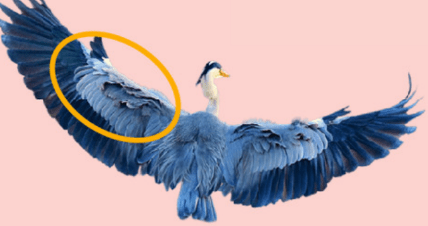
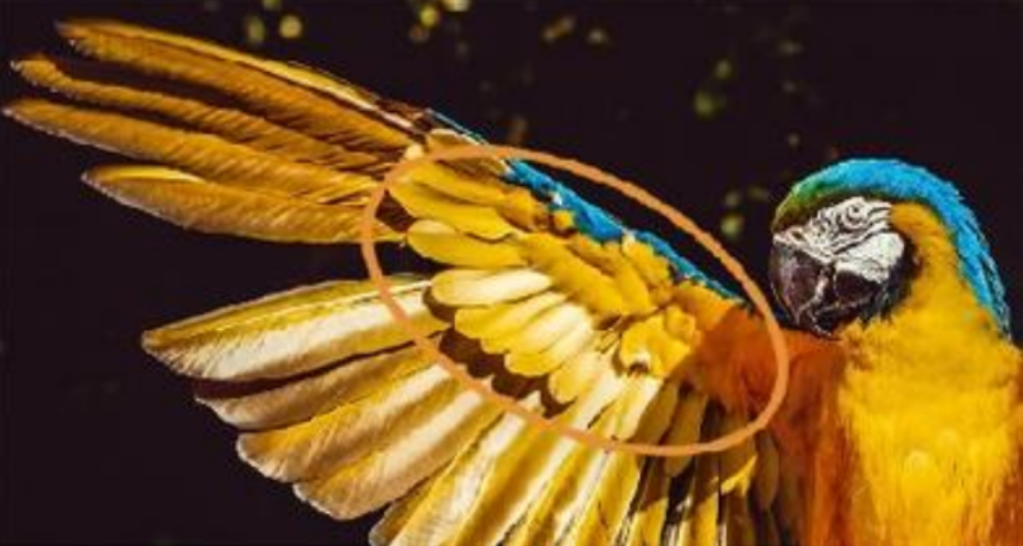
Upper (left) and lower (right) covert feathers on birds’ wings. The upper covert feathers are shown deployed.
The team, led by professor Aimy Wissa, tested whether they can improve the flight performance of small aircraft by mimicking these covert feathers. They wanted to reduce stalling, which is when the amount of lift, or upward force, that an airplane wing creates drops suddenly. This happens when the angle of the wings is steeper than a given angle, known as the critical angle of attack, and can cause the pilot to lose control of the airplane. Stalling can be caused by climbing too steeply, by flying too slowly, or by ice accumulating on the wrong part of the wing. In airplanes, the critical angle of attack is fifteen degrees. However, birds can remain in flight when the angle of their wings is much steeper, and the covert feathers may help with this.
Wissa’s team created flexible flaps meant to mimic covert feathers, and attached five rows of these flaps to a small airplane wing. In a wind tunnel, they measured the effects of these flaps on the airflow around the wing, first with each flap separately, and then in combination with each other. The researchers found that each flap interacted with the stream of air from the flaps directly in front of or behind it, causing more vortices in the air around the flaps. This decreased the size of the wing’s wake, or the area of low pressure directly behind the wing, which increased the lift created by the wing, and reduced drag. In these wind tunnel tests, the researchers found that when all five rows of flaps were attached, they measured an increase of lift of up to 45%, and a decrease in drag of up to 31%. They also found that with all of the flaps attached, the amount of lift created by the wing was more stable across a range of angles, without a sudden drop around the critical angle.
To test whether these differences could actually affect an airplane in flight, the team attached three rows of these flaps to a remote-controlled model airplane. They deliberately stalled the airplane by gradually increasing the angle of attack until the plane stalled, and measured the amount of lift created, how long it took for the airplane to stall, and how quickly they lost control of the airplane after stalling. The researchers found that when they added the flaps, the critical angle of attack was increased by 9%, and the airplane was far less likely to lose control within a few seconds of stalling compared to without the flaps.
Wissa and her team are optimistic that their flap design can be scaled up to help make commercial airplanes safer and more stable. Because these flaps deploy on their own, powered only by changes in air pressure, researcher Girguis Sedky says in a press release that they could be “an easy and cost-effective way to drastically improve flight performance”. These findings are also interesting for biology, and Wissa is optimistic about future collaboration with biologists to learn more about how birds fly.
 Bridging Science