
This article was written for the course History and Philosophy of Science 2024.
The story of Phineas Gage
What the reports on Phineas Gage reveal about the mental recovery after a tamping iron passed through his head, and what his legacy has been.
by Cecile Bruil
“A very severe, singular, and hitherto unparalleled case” – Harlow about Gage’s case in 1848
Who is Phineas Gage?
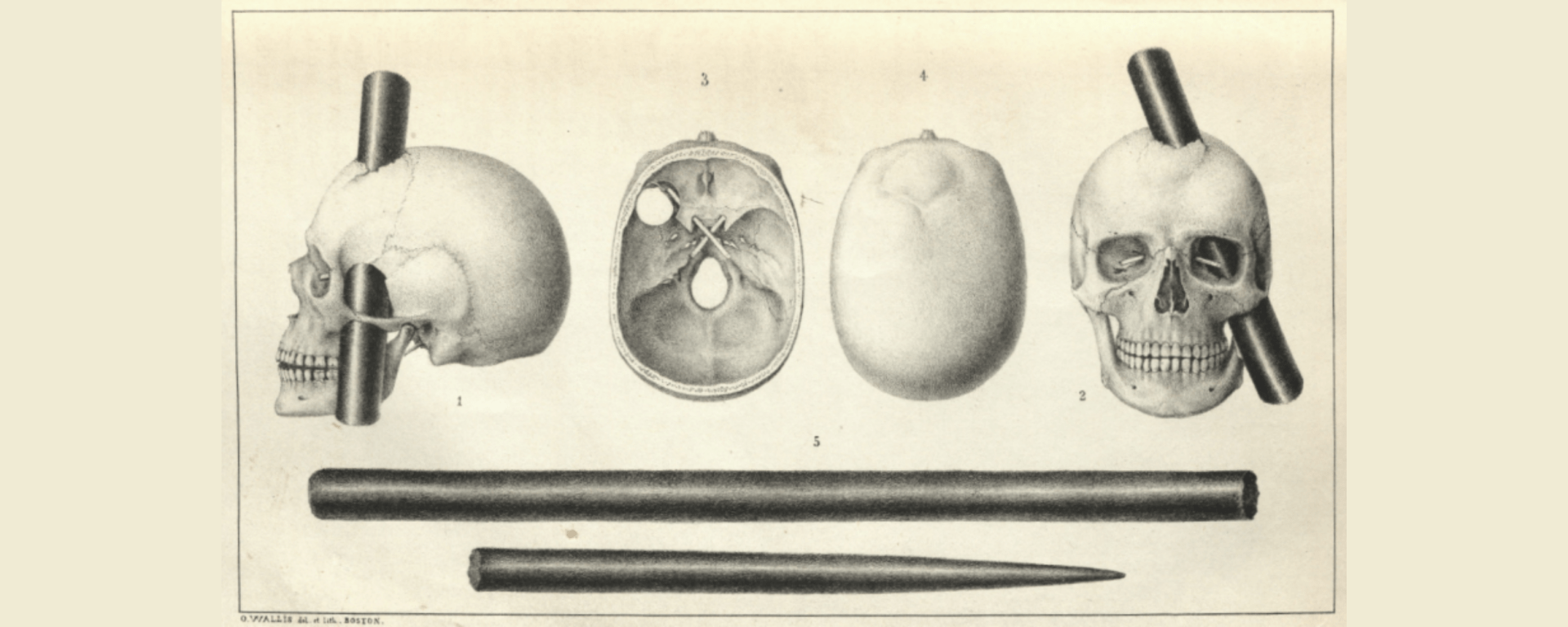
Phineas Gage (1823-1860) was an American foreman at the railroad of Cavendish, in the USA. On the 13th of September 1848 an accident at work led to a tamping iron passing through his left cheek and exiting through his skull1. Miraculously, Gage survived the accident thanks to the care of local physician John Martyn Harlow (1819-1907).
Nowadays, Gage is seen as a textbook example in both psychology, neurology and philosophy textbooks for personality changes after brain damage. This essay explores what the actual reports on Gage reveal about his mental recovery, detailing what we know about Gage’s life before and after the accident. This essay will also reveal that Gage did not directly impact the development of psychosurgery. Furthermore, we will see that the limited reports on Gage’s personality have been misinterpreted to fit narratives about personality change in modern philosophy. Gage has left a legacy of myths, but this essay tries to reveal some of the truths based on the historical reporting done by Dr. Harlow.
“The case occurred in an obscure country town” – Harlow on the recovery of Gage 1868
Setting the scene
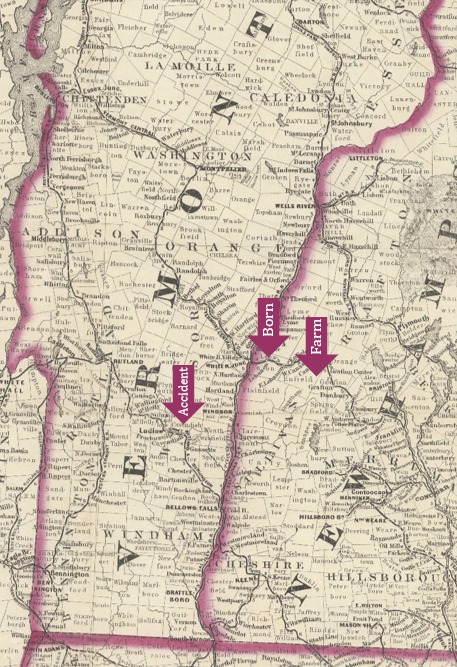
Gage was born on the 9th of July 1823 in Lebanon, New Hampshire, in the USA. His family consisted of his father, Jesse Gage, mother, Hannah Swetland, and his four younger siblings. He grew up on his grandparents’ farm in the neighbouring town Enfield, where he was schooled2 (Macmillan, 20003).
In 1848, Gage was working as a foreman on the Vermont railroad constructions which had started back in 1843 (Harlow, 1868; Thompson, 1842).
Gage was described as an ordinary, perfectly healthy and strong 25-year-old man, having an iron will, full of energy, smart, and persistent in executing plans (Harlow, 1848, 1868).
That is about all we know of Gage’s life before the accident. It is very limited as many things were sadly not documented or kept.
“The iron entered there and passed through my head” – Gage while pointing to his left cheek in 1848
What happened to Phineas Gage?
On Wednesday September 13th 1848, at 16:30, Gage was working on the Rutland and Burlington Railroad in Cavendish. When preparing for an explosion, Gage filled a hole in a rock with powder and tampered it slightly with a metal tamping iron4. When the iron came into contact with the rock, the powder exploded, driving the tamping iron through the left side of Gage’s face, and exiting through his skull. The iron passed behind Gage’s left eye, and disrupted part of the left frontal lobe of his brain. The force of the accident threw Gage on his back, though he was conscious quickly after. Gage’s workmen witnessed the accident and carried the injured Gage to the road where he was taken with an ox cart to a nearby hotel. Here, Gage’s wound was taken care of by Dr. Williams and by local physician Dr. Harlow5 (Harlow, 1848).
“I dressed him, God healed him” – Harlow on the recovery of Gage in 1868
Recovering from the accident
Dr. Harlow remained caring for Gage6 and reported the recovery in detail. Harlow removed the loose pieces of skull and applied bandages to the head, but besides that, he mostly observed and only interfered when treatment was needed (Harlow, 1848, 1868). Therefore, Harlow did not experiment with Gage and wrote that he would not probe through the wound as to not disturb the blood vessels.
Harlow was very adamant about not probing the wound, even though this could have denied the scepticism from the ‘medical people’ that was present from the very beginning. These medical people were Metropolitan Doctors who refused to believe one could survive an accident like this, and were not convinced of the occurrence of the accident until much later7 (Harlow, 1868).
The documentation of the physical recovery was done in a detailed manner, noting changes in characteristics such as pulse, wound appearance, sleeping behaviour, and the moment when Gage lost his left eye vision8. Additionally, Harlow made some notes about Gage’s behaviour, attitude and mental state, which differed greatly per day (Harlow, 1848). Although, in comparison to his detailed description of the physical state, the mental descriptions were shallow and vague, leaving many things open to interpretation.
Harlow changed Gage’s bandages three times daily, kept ice water on the face for cooling, and cleaned the wound discharge (Harlow, 1868). It is due to this great effort that Gage was able to recover and move back to his home in Lebanon on the 25th of November 1848. Harlow does not take great pride in the recovery as he attributes Gage’s recovery to favouring circumstances10 and God.
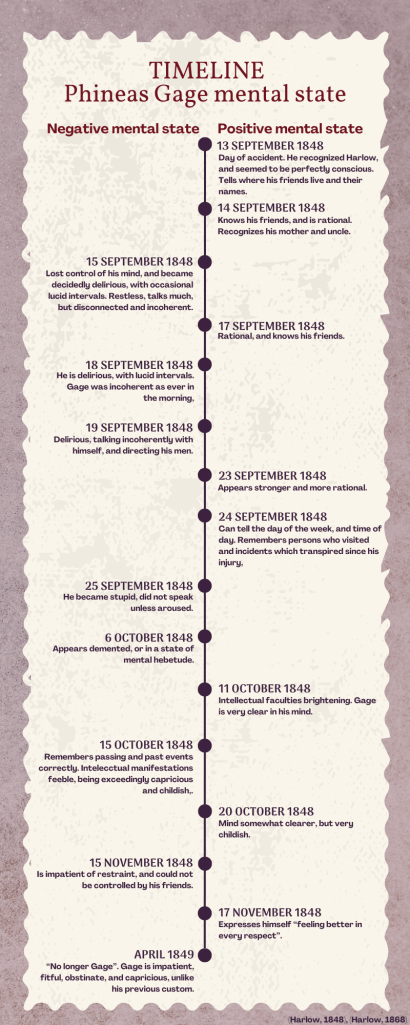
“Gage is undecided whether to work or travel” – Harlow 1868
Life after the accident
After Gage went home Harlow did not see him regularly anymore. When Gage visited Harlow in April 1849, his physical condition was good, however, his mind had changed. The “balance between intellectual faculties and animal propensities had been destroyed”11 and Gage was now “fitful, obstinate, and capricious”12 according to Harlow. His mind had so radically changed that according to Gage’s friends he was “no longer Gage”. This led to the conclusion that physically, the recovery was complete, yet, mentally, only partial (Harlow, 1868).
Besides the change in his mind, Gage was still able to have a job, live independently, and travel for eleven years. For example, Gage worked in Chili for a couple of years where he would drive a coach driven by six horses, and care for them (Harlow, 1868). This was a job that required multitasking, planning, and responsibilities, which Gage was able to do.
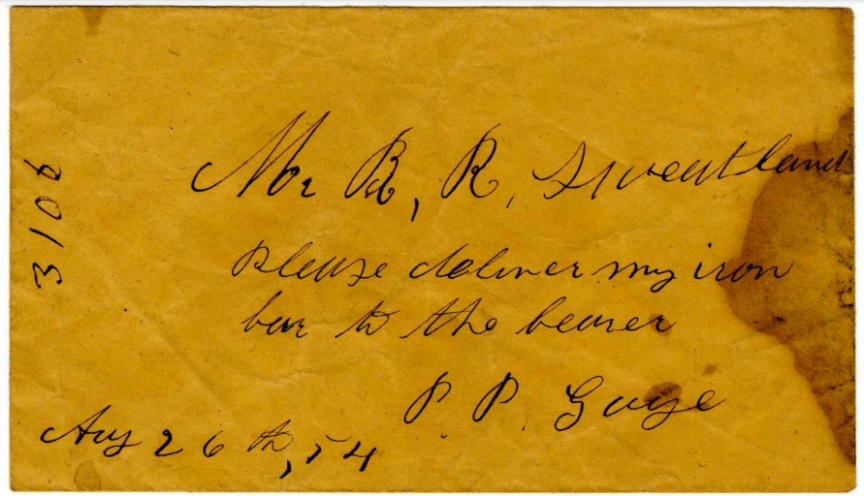
Gage’s mother noticed that Gage developed a new behavioural trait; he grew more and more attached to his tamping iron over the years. The iron was on display in the Warren Anatomical Museum in 1854, but Gage wrote a note asking to get it back. From then on he carried his iron with him for the remainder of his life (Harlow, 1868).
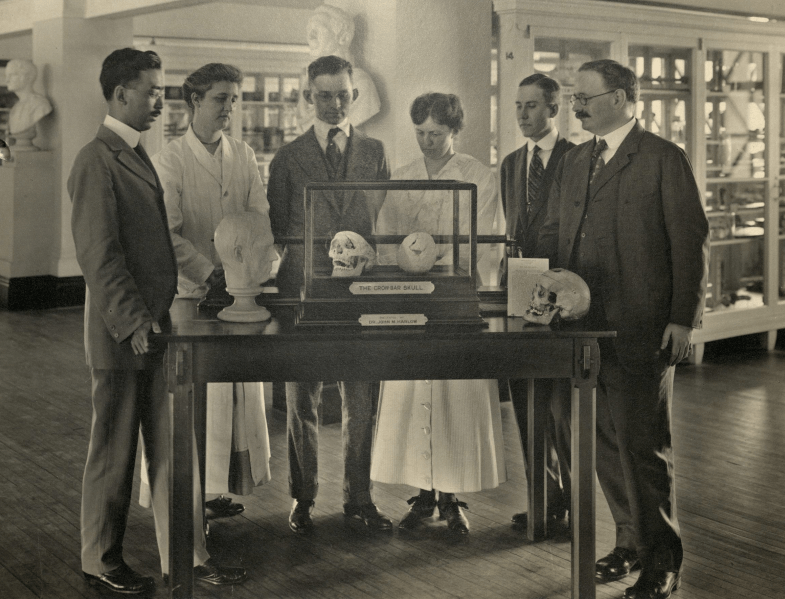
Gage died on May 20th 186013 at the age of 36 from epileptic attacks. His family allowed Dr. Harlow to study Gage’s skull for his second paper on Gage in 1868 (Harlow, 1868; Macmillan, 2000). The skull, and the tamping iron, were donated to the Warren Anatomical Museum by Harlow in 1868.
“In investigating the reports on diseases and injuries of the brain I am constantly being amazed at the inexactitude and distortion to which they are subjected by men who have some pet theory to support” – Scientist David Ferrier writing to Henry Bowditch about Gage in 1877
Impact on psychosurgery
In the late 19th century the neuropsychology discipline did not exist yet. The term ‘neuropsychology’ was first used in 1913 by William Osler, but the true development of the scientific field was in the 1980’s (Bruce, 1985; Kolb & Whishaw, 1980). Because the neuropsychology field did not exist in 1848, very little was done by scientists to understand Gage’s personality before and after the accident, leaving us in the current day with only a few descriptions from Harlow.
Nevertheless, Gage’s case is said to have had a major impact on neuropsychiatry and the development of psychosurgery and lobotomy, with statements such as “Gage’s case provided the basis for the first modern theories of the prefrontal cortex’s role in both personality and self-control” published in psychology textbooks14 (Gazzaniga, 2018), or “Gage’s case had a tremendous influence on early neuropsychiatry” (Teles, 2020). However, there is a lack of evidence that Gage impacted any of the major developments in the field.
The first set of psychosurgeries was performed by Gottlieb Burckhardt (1836-1907) in 1899. Out of his six experimental operations, he removed part of the frontal lobe in one of his patients. In his paper outlining the operation, Burckhardt does not mention Gage, nor does he cite literature which does15 (Burckhardt, 1891; Macmillan, 2000). For this reason, we can believe that Burckhardt either did not know of, or, did not think Gage’s case important enough to be cited. Either way, Gage did not impact Burckhardt’s decision for frontal lobe removal.
Years later, in 1936, the leucotomy procedure was developed by António Moniz (1874-1955) as a procedure to treat psychoses. This procedure was from then on further developed by Walter Freeman (1895-1972), and renamed lobotomy. Moniz, like Burckhardt, did not cite Gage anywhere in his paper, instead Moniz’s theory behind the leucotomy procedure was largely based on his own idea about the working of the frontal lobe. Furthermore, Gage’s case would not have supported Moniz’s theory as Gage did recover physically, but not fully mentally. This is opposite to Moniz’s idea, as he was keen on citing cases in which the patients were mentally “cured” (Macmillan, 2000; Moniz, 1936a, 1936b, 1954).
The developer of the lobotomy procedure, Freeman, did mention Gage briefly at a conference in 1936, yet, we have reason to believe that this was accidental. Freeman was not prepared to talk at the conference, but when journalists pressed him to talk about lobotomy, he mentioned Gage16. However, this mention cannot be found in any of Freeman’s papers, implying that he did know about Gage’s story, but that it is not connected to the lobotomy operation (Freeman & Watts, 1942; Freeman & Watts, 1950; Macmillan, 2000).
Now you see that the claims about Gage impacting psychosurgery and neuropsychology lack supporting evidence. Given the extensive literature background found in some of the papers, it is odd for Gage not to be mentioned if he indeed impacted the development of any of the psychosurgeries. Therefore, we can say that Gage did not have a direct impact on the major developments in the psychosurgery discipline.
“A moral man, Phineas Gage,
Tamping powder down holes for his wage,
Blew the last of his probes
Through his two frontal lobes;
Now he drinks, swears, and flies in rage.”
– Poem by unknown author about Gage
Becoming a textbook example
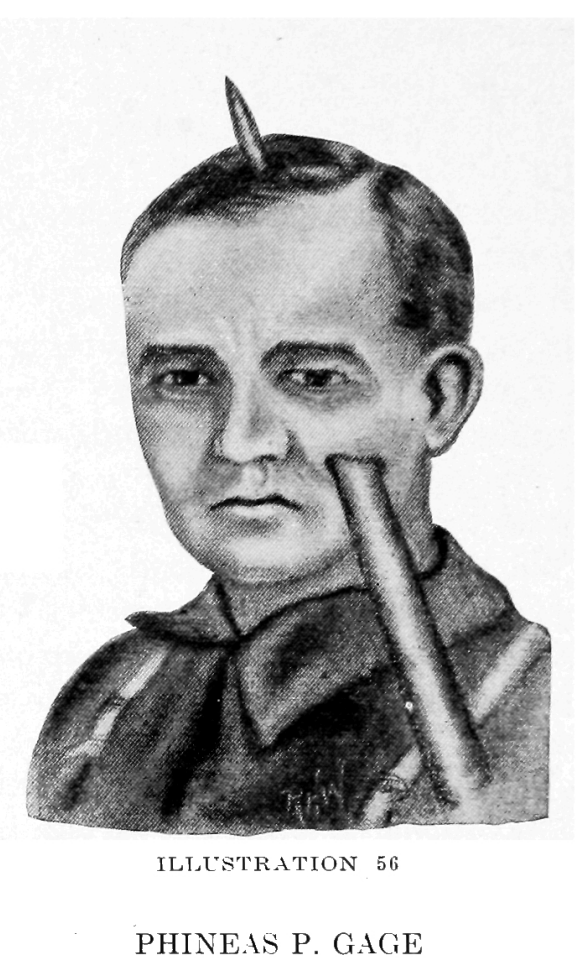
Nowadays Gage can be found in various neuroscience, psychology, and even philosophy textbooks, often being described as a good man turned cruel17 and with many more statements about his altered personality which do not match the short description of Gage’s personality given by Harlow (Harlow, 1868).
One neurologist, Antonio Damasio (1944-present), is said to have boosted the popularity of Gage’s story beyond neuroscience. In his book on the role of emotion in thinking, he claims that rational choices are determined by emotions, which he based on a patient that reminded him of Gage (Kessels et al., 2017). Yet, the view Damasio has of Gage does not match the information we have. Damasio describes Gage as drinking and brawling, lacking thoughts about the future, unable to hold a job, and parading his self-misery (Damasio, 1994).
This view of Gage led Damasio to believe that the philosopher René Descartes (1596-1650) was wrong in his view of emotion and thinking. Descartes, who is known for “I think, therefore I am”, believes the rational thinking is the fundamental process behind emotions. Whereas Damasio now argues that rational thinking is determined by your emotional state, as he ‘proves’ by Gage’s changed personality after the accident. This ‘proof’ is that Gage’s personality is his emotional state. This emotional state changed because of the accident, therefore, his rational thinking is now also changed, according to Damasio (Damasio, 1994; Kessels et al., 2017).
“What about me, here and now, makes me the same person as the person who bore my name and lived in my house 20 years ago?” – Philosopher Searle on personal identity (2005)
What makes you… you?
Damasio is not the only one who challenges philosophical ideas based on Gage’s case. In philosophy Gage is still used to substantiate theories regarding shifts in personality. With even the ‘Phineas Gage Effect’ coming into existence.
The ‘self’ and ‘personal identity’ have been a classical topic among philosophers for decades. What about someone makes them the same person as thirty years ago? What if they change drastically, are they the same? By now, most philosophers agree with David Hume (1711-1776) that the ‘self’ does not exist18. Rather, we all have a physical body, and a sequence of experiences in that body which forms who we are.
We do all have personal identity, and criteria that allow judging whether someone has the same identity across time (Searle, 2005). The four agreed upon criteria for personal identity are:
- Spatiotemporal continuity of the body
- Continuous memory
- Continuity of personality
- Coherence of physical change
Because Gage’s personality changed after the accident, and his friends said he is “no longer Gage” (Harlow, 1868), the relative stability and continuity of personality is not met. Therefore, in a literal sense (government name, possessions, etc) Gage would still be Gage, but, in philosphical terms, he would no longer have the same personal identity and therefore no longer be the same person (Searle, 2005).
Experimental philosopher Tobia took on this idea and performed an experiment regarding the perception of personal identity change over time. He had 140 participants who he told a short story about Gage’s accident and personality. Half got a story where Gage went from a kind man to a cruel man after the accident, and the other half got the same story but with the words ‘kind’ and ‘cruel’ reversed. After the story, participants were asked whether they judge Gage to be the same person after the accident.
The conclusion is that people are likely to judge someone to be the same person if the major shift in personality is for the better, whereas they will judge someone a different person when the change is for the worse. This asymmetry in judgement is referred to as the ‘Phineas Gage Effect’ (Tobia, 2015).
Gage’s legacy
Having an effect named after you in philosophy is a legacy to leave. It’s only a shame that it is based on behavioural characteristics which are not accurate to the historical records.
“The leading feature of this case is its improbability” – Bigelow about Gage in 1850
Gage’s case is extraordinary because of the unlikeliness that one could survive an iron bar passing through the head. That is what Gage should be remembered for, not the stories postulated years later that claim Gage started psychosurgery, or that he became a cruel man, which are still omnipresent 164 years after his death.
In the end, Gage’s legacy is the remarkable strength of the body to recover from such an accident, rather than the myths that have evolved around his case.
Footnotes
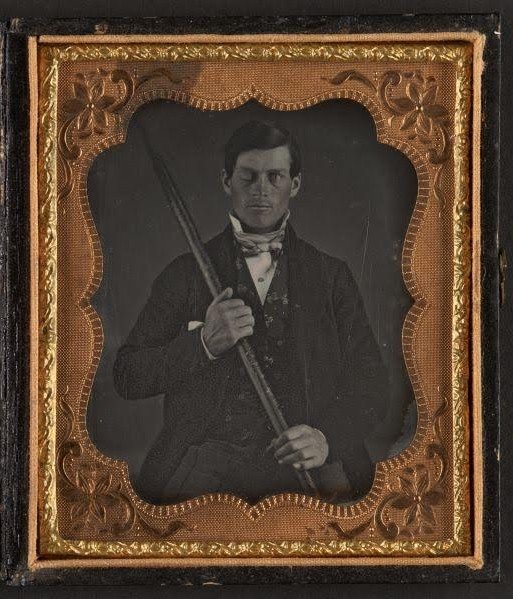
- On the image it looks like the iron passed through Gage his right side. This is not the case, due to the nature of daguerreotypes, a type of photography invented in the mid 1800’s, the image was laterally reversed, creating the impression that the injury is on the right rather than the left side of his face.
- There are many unknowns regarding Gage’s past. His date, nor place, of birth is confirmed. We are not certain whether he grew up on his grandparents’ farm, and there are no records of Gage being schooled, though there is evidence of Gage reading and writing proficiently. It is also unknown where Gage worked prior to the railroad. Statements are made on the best possible sources available, though none are confirmed.
- Malcolm Macmillan (1929-present) is an Australian psychologist who worked as a lecturer and adjunct professor for the Monash University and Deakin University. He wrote the book ‘an odd kind of fame: stories of Phineas Gage’. In his book he goes out of his way to verify his sources. For his book, Macmillan got the Association of American Publishers award for professional and scholarly excellence in the category History of Science and Technology in 2000. For these reasons, I found Macmillan, and his book on Gage, to be a credible and reliable secondary source.
- The tamping iron is three feet and seven inches in length (109.2 cm), thirteen and one quarter pound heavy (6.0 kg), is rounded with a diameter of one and one quarter inch (3.2 cm) and has a pointed end (Harlow, 1848).
- Dr. Harlow did not arrive on the scene until 18:00 that evening. Therefore, the account of what happened was based on both Gage his own recollection of the accident, as well as that of by-standers, his working men, who witnessed the accident.
- Harlow was relatively unexperienced at the time, he graduated only four and a half years before the accident. Nevertheless, his care and examination were very skilful (Macmillan, 2000).
- After Harlow obtained Gage’s skull and the reported about this in 1868, Harlow argues that with the facts presented, even the most sceptical must now be convinced of the actual occurrence (Harlow, 1868).
- Miraculously the iron bar did not hit the optic nerve. Therefore, Gage was still able to see from his left eye after the accident. Due to wound inflammation and infections Gage did lose his left eyesight eventually, ten days after the accident (Harlow 1868).
- Harlow did not suspect Gage to survive. He mentions that in the week following the accident, it had not occurred to him that a recovery was possible. Neither did Gage’s friends, they were in such expectancy of his death, that they had his coffin and clothes ready for his remains to be brought to his hometown (Harlow, 1868).
- Four favouring circumstances are described by Harlow. 1) The physique, will capacity, and endurance of Gage. 2) The pointed shape of the tamping iron. 3) The exact place were the skull was fractured. 4) The destroyed brain portion was the best fitted to sustain the injury (Harlow, 1868).
- Although it becomes clear from Harlow’s description that Gage has changed mentally, some of his descriptions remain ambiguous. We do not know what he meant by ‘animal propensities’, nor do we have clear documentation of Gage’s personality before the accident.
- Fitful: having an irregular character. Obstinate: stubborn and resistant to change. Capricious: impulsive and unpredictable behaviour.
- Although Harlow mentions the death date to be May 21st 1861 in his paper, the actual death date is likely to be a year earlier. This discrepancy was found by Macmillan who set out to find the original documentation of his death / burial. In doing so, Macmillan found the cemetery document of Laurel Hill Cemetery, in which the death date was noted as May 20th 1860 (and the burial May 23th 1860). Also, the funeral record of Lone Mountain Cemetery gives the funeral date of Phineas Gage to be May 23th 1860, alongside the cause of death being ‘epilepsy’ (N. Gray and Co’s Funeral record 1850-1862)(Macmillan, 2000). Therefore, I believe that Gage died May 20th 1860, nearly eleven and a half years after the accident.
- This textbook is currently still used in the University of Groningen for the bachelor Psychology. The book also includes the wrong statement that “Gage lapsed into unconsciousness and remained unconscious for two weeks”. Gage did not lose consciousness after the accident, as reported by Harlow in 1848.
- The original papers from Burckhardt and Moniz are written in respectively German and Portuguese. These are languages I do not speak fluently, therefore the statements about those papers are based on the book of Macmillan.
- It is unknown what Freeman said exactly about Gage during the conference in 1936 (Macmillan, 2000).
- A commonly held belief is that Gage turned into an aggressive, cruel and nasty man after the accident. This is not in any way described in the original documentation of Harlow. These blatant lies and exaggerations are widespread on webpages and blogs about Gage which have either no, or unreliable sources. Nonetheless, their portrayal of Gage has become the public’s perception of him, as every single lecturer who taught me about Gage also described him as a cruel man.
- The ‘self’ being described as a soul, an entity aside from your experiences and body (Searle, 2005).
References
Bigelow, H. J. (1850). Bigelow’s case of injury of head. The American Journal of the Medical Sciences, 20.
Bruce, D. (1985). On the origin of the term “neuropsychology”. Neuropsychologia, 23(6), 813-814. https://doi.org/https://doi.org/10.1016/0028-3932(85)90088-0
Burckhardt, G. (1891). Ueber Rindenexcisionen, als Beitrag zur operativen Therapie der Psychosen. Druck und Verlag von Georg Reimer. https://doi.org/10.3931/e-rara-17197
Damasio, A. R. (1994). Descartes’ Error: Emotion, Reason, and the Human Brain. Putnam.
Ferrier. (1877). Correspondence Sir David Ferrier to Henry Bowditch. In: Harvard.
Freeman, W., & Watts, J. W. (1942). Psychosurgery: Intelligence, emotion, and social behavior following prefrontal lobotomy for mental disorders [doi:10.1037/11151-000]. Baillière, Tindall & Cox. https://doi.org/10.1037/11151-000
Freeman, W., & Watts, J. W. (1950). Psychosurgery in the Treatment of Mental Disorders and Intractable Pain. C. C. Thomas. https://books.google.nl/books?id=39ugxwEACAAJ
Gage. (1854). Handwritten note from Phineas Gage to Warren Anatomical Museum. In: Harvard.
Harlow, J. M. (1848). Passage of an iron rod through the head. The Boston Medical and Surgical Journal, 39(20).
Harlow, J. M. (1868). Recovery from the passage of an iron bar through the head. The Boston Medical and Surgical Journal.
Kessels et al. (2017). Clinical neuropsychology. Boom.
Kolb, B., & Whishaw, I. Q. (1980). Fundamentals of Human Neuropsychology. W. H. Freeman. https://books.google.nl/books?id=jvV9AAAAIAAJ
Macmillan, M. (2000). An odd kind of fame : stories of Phineas Gage. MIT Press.
Moniz. (1936a). Essai d’un traitement chirurgical de certaines psychoses. Masson.
Moniz. (1936b). Tentatives opératoires dans le traitement de certaines psychoses. Impr. alençonnaise. https://books.google.nl/books?id=vAUTAQAAMAAJ
Moniz. (1954). I succeeded in performing the prefrontal leukotomy. J Clin Exp Psychopathol, 15(4), 373-379.
Searle, J. R. (2005). 72 The Self as a Problem in Philosophy and Neurobiology. In T. E. Feinberg & J. P. Keenan (Eds.), The Lost Self: Pathologies of the Brain and Identity (pp. 0). Oxford University Press. https://doi.org/10.1093/acprof:oso/9780195173413.003.0002
Thompson, Z. (1842). History of Vermont, Natural, Civil, and Statistical. For the author, by C. Goodrich. https://books.google.nl/books?id=M6xFv628ziMC
Tobia, K. P. (2015). Personal identity and the Phineas Gage effect. Analysis, 75(3), 396-405. http://www.jstor.org/stable/24671350
Unknown. (1855). Sixth plate cased daguerreotype of Phineas Gage. In: Harvard.
unknown. (1915). Dr. Elmer E. Southard with visitors looking at the ‘crow-bar skull’ preserved by Dr. Harlow. In: Harvard.
Windsor, W., & Windsor, R. H. (1921). Phrenology : the science of character. Ferris-Windsor Company. http://search.ebscohost.com/direct.asp?db=pzh&jid=%22200905566%22&scope=site
Woolworth. (1860). New England 1860 [Maine, New Hampshire, Vermont, Massachusetts, Rhode Island, Connecticut and Lower Canada, 1860]. New York, New York: G. Woolworth Colton. https://collections.lib.uwm.edu/digital/iiif/agdm/28636/full/full/0/default.jpg
 Bridging Science
