

By Cecile Bruil
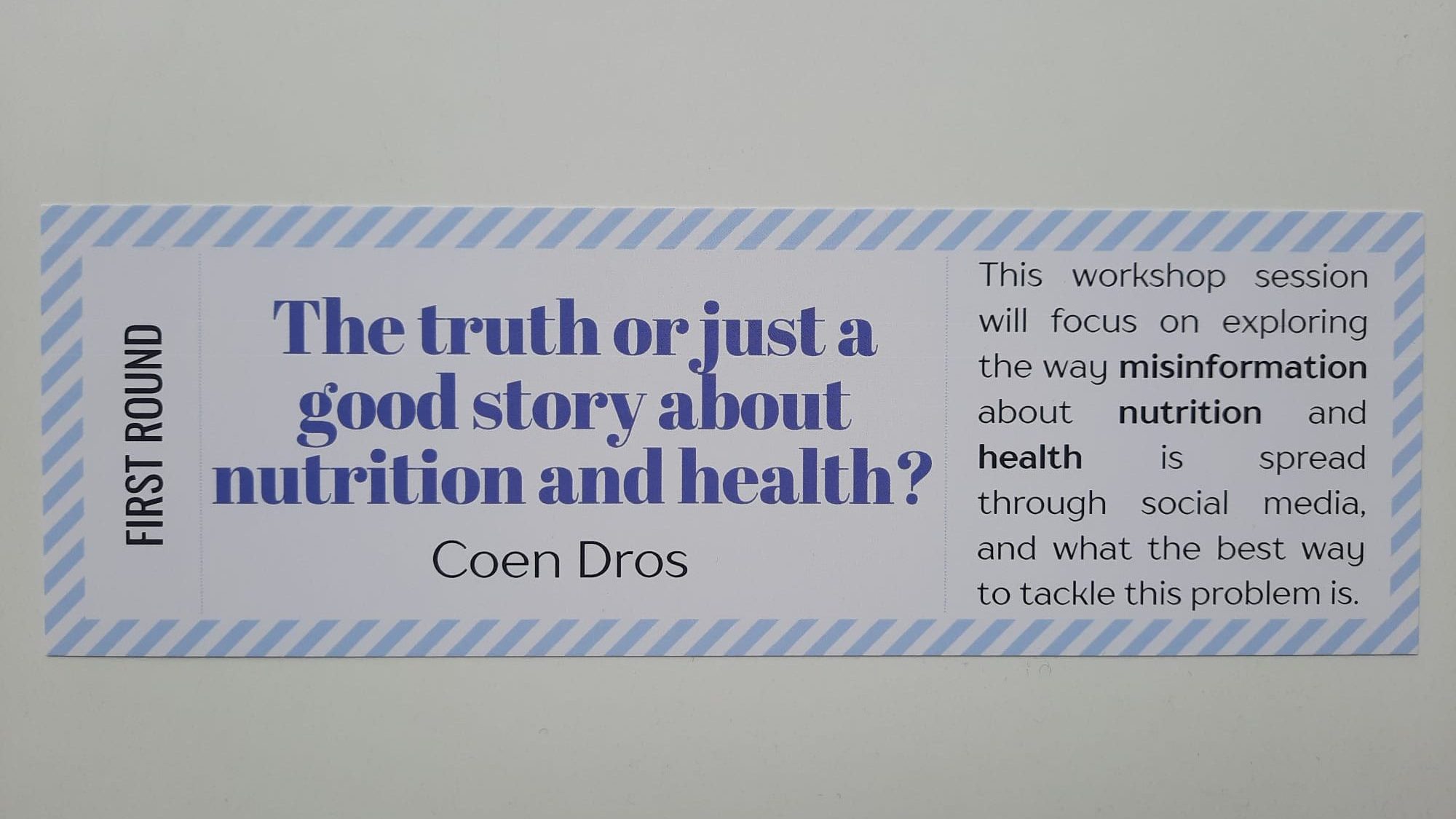
Last week the Science Communication Conference 2025 was held at the VU Amsterdam. The day was filled with interesting keynote speakers and a variety of workshops all revolving around the central theme ‘societal change’. For my first workshop of the day I chose to attend ‘The truth or just a good story about nutrition and health?’ by Coen Dros. If you were sadly unable to attend this workshop, worry not, because in this article I will give you a guide (as provided by Coen) to become an expert in spotting misinformation on social media.
You must have seen them once, twice, or dozens of times. Those flashy videos on social media making claims about what foods you should never ever eat again. Or others claiming certain foods to be able to resolve all your problems. In these videos, flashy headers of research papers fly across the screen to seemingly confirm every bold statement that is made. However, are these research articles really providing evidence? According to Coen the research evidence does not support the claims that are made in these videos.
The process of seeing whether the claims align with the provided research is what Coen calls science-checking. For this he has made a simple checklist to follow whenever you come across a video that might feel too good to be true.
Step 1. The question
What is the question the video is trying to answer? And what is the question the research paper is trying to answer? This sounds obvious, but oftentimes these two questions do not align. They try to answer different questions, therefore the answers will not be comparable. Though, on social media one answer is often used to answer a different question. Therefore, check the aim of the study and look further than the abstract to really find the asked questions of the researchers.
Step 2. The comparison
You cannot compare apples to oranges, so you also cannot compare different exposure rates, outcomes, and test groups. So always ask yourself ‘compared to what?’ when reading the research paper and check if this matches with the social media video.
Step 3. The answer
Since you are scientifically educated, you should be able to determine the answers of a research paper yourself by checking the graphs. While the graphs tell the story as it is, the words can give a framed outlook on the same results. “Just because something is on PubMed does not mean it’s good science” said Coen. So determine the answer and compare this to the answer the social media video is feeding you.
Step 4. The quality
Now we are on step four, though according to Coen it does not often go this far. More often than not the mistakes are made in step one, two or three. But in case everything is still okay there, you can move on to step four and five. In this step you check whether the used research evidence is actually of good quality. Did they perform the correct tests, and had the correct test groups, etc. If the quality is not there, it’s not a great back-up for bold claims.
Step 5. The body of evidence
Lastly, if everything else checks out, the last thing to take a look at is the body of evidence provided. Is there more research that backs up the claims? Or is it a single study? This doesn’t have to be a problem, but the larger the body of evidence is, the better we can determine the evidence is good.
Once you have checked these steps, you should be able to know whether a visually appealing social media video is actually based on good evidence, or if misinformation is being spread. Coen pointed out that it is oftentimes misinformation, and not disinformation, as there is often no ill intent in the actions of the content creators. It is often just a lack of knowledge and scientific literacy that can lead to misinformation, so be empathetic and possibly help the creators and public understand when a research paper supports the bold claims in a video, and when not.
 Bridging Science