

This article was written for the course History and Philosophy of Science 2024.
Bridging Science and Art: Charles R. Knight and the Enduring Influence of Paleoart on Public Perception
By Cristina Pop
Introduction
Tyrannosaurus rex, or T. rex, is one of the most recognizable dinosaur species, famous in both scientific and popular culture. A symbol of both prehistoric mystery and scientific curiosity, its fame is so widespread that even young children can identify and share “facts” about its habits. However, the public image of T. rex as a towering, tail-dragging predator – an image dating back to its original description in 19051– often doesn’t align with what scientists have known for over half a century. Since the late 1960s, experts have reinterpreted T. rex as an agile animal with a more horizontal posture and tail raised from the ground. Yet, as recent research has shown, most people still picture T. rex in its outdated, upright pose, an image ingrained by early educational materials, toys, and popular media2 (Ross, Duggan-Haas, & Allmon, 2013).
This enduring misconception sheds light on how public understanding of science can lag behind scientific advancements, influenced by early cultural exposures and the way information is presented to non-experts. Science communication has a long-lasting impact, especially when science is brought to life through imagination, interpretation, and popular media. In the case of paleoart, which combines scientific accuracy with artistic representation to bring extinct worlds to life (Ansón, Hernández Fernández, & Saura, 2015), misconceptions can be especially powerful. These artworks offer insight and inspire awe, but they can also embed outdated views within the public consciousness. However, even imperfect representations can spark curiosity and engagement with science, as seen in the works of Charles Robert Knight (1874 – 1953), a renowned early 20th-century paleoartist who helped shape public perceptions of prehistoric life. Knight’s paintings and murals, such as his dynamic portrayal of T. rex and Triceratops in battle, conveyed a sense of movement and vitality that was largely absent from scientific illustrations of his time.

In this essay, I argue that Knight’s work exemplifies a necessary collaboration between science and art, which, while sometimes sacrificing precision, succeeds in fostering public engagement and interest. I will begin by tracing the evolution of paleoart alongside shifting scientific views on dinosaurs, highlighting how artists like Knight shaped public understanding. I will then show how Knight’s unique interpretations anticipated scientific advancements, such as the shift from viewing dinosaurs as slow, lumbering creatures to seeing them as more dynamic, active animals. Lastly, I will discuss the lasting influence of his work on popular media and how his legacy as a nearly blind artist exemplifies resilience and passion in science communication. Knight’s career reminds us that, even when susceptible to change over time, art continues to play a vital role in making science accessible and sparking curiosity about our prehistoric past.
Bringing prehistory to the public
A stunning 25.2-metre-long blue whale skeleton greets visitors as they enter the main hall of the Natural History Museum in London (Natural History Museum, 2017). Suspended high above the hall, Hope, the female blue whale, offers every visitor the opportunity to walk beneath the largest creature to have ever existed and marvel at its sight, a humbling reminder of nature’s vastness. Lucky few even get to spend the New Year’s Eve partying under Hope, with music, dancing, and special nighttime gallery access (Natural History Museum, n.d.) – a modern tradition with historic echoes.
It was one week before New Year’s Eve in 1853, when a select few had received intriguing invitations to a similar event (The Illustrated London News, 1854). Sculptor Benjamin Waterhouse Hawkins was hosting an eccentric dinner within the clay mold of an Iguanodon statue. The banquet was meant to showcase one of the first completed models for the upcoming Crystal Palace Dinosaur exhibit in London. Twenty-two notable guests3, including prominent scientists, journalists, and business leaders, dined inside this massive sculpture that represented a new era for public engagement with paleontology (Witton & Michel, 2022).
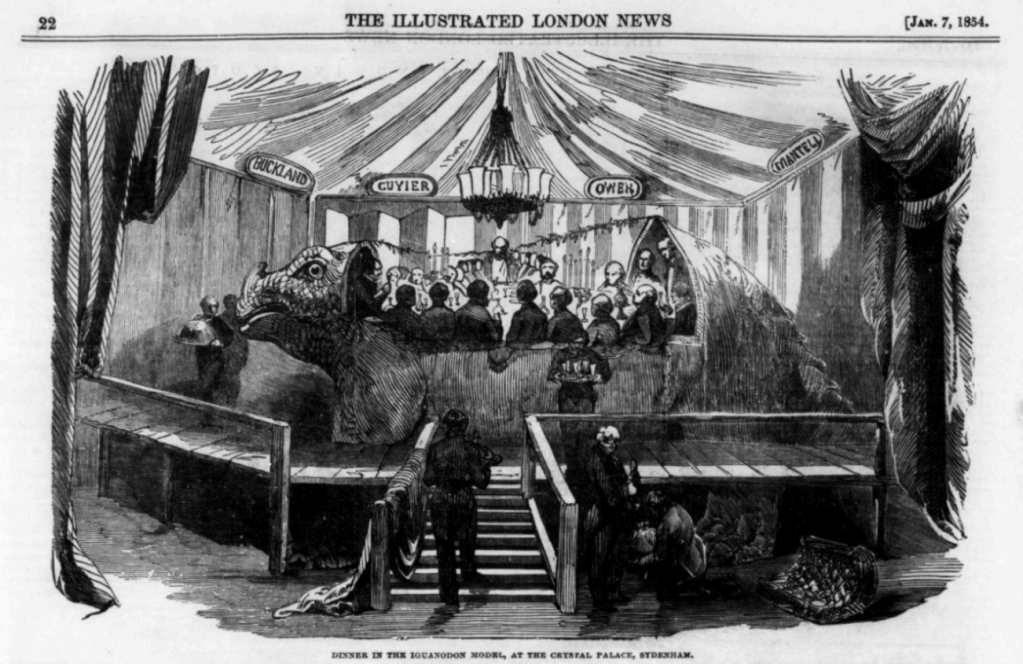
Six months later, in June 1854, the Crystal Palace Park was finally opened to the public. The dinosaur exhibition was partly unfinished and Hawkins was still working on constructing some of the models. Despite its unfinished state, the public received it well. Visitors could step into worlds far away by witnessing representations of not only dinosaurs4, but also recreations of geological features, extinct plants, mammals and reptiles.
To create the life-sized models, Hawkins collaborated with Sir Richard Owen, one of the most prominent paleontologists of his day. Their goal was to reconstruct these extinct animals in settings reflecting the latest scientific understanding, showcasing dinosaurs and other creatures in simulated landscapes (Witton, 2018). Soon, however, critics from the scientific community began to question the accuracy of the models. The 19th century was a time of rapid advancement in geosciences and paleontology, and the understanding of extinct animal anatomy was still evolving. As a result, the models in Crystal Palace Park became increasingly vulnerable to new discoveries and reinterpretations. It didn’t take long for scientists to recognize that some of the species represented in the park were no longer accurate.

The Iguanodon model was the most famous exhibit of the Crystal Palace. The most immediate and widely discussed criticism of the Iguanodon sculptures was the decision to depict a nasal horn5. Even during the construction of the model there were doubts regarding whether the bone was actually a nose horn. Later fossil discoveries in the 1860s and 1870s further challenged this interpretation, and began to show that Iguanodon was not as massive and thick-limbs as depicted in the Crystal Palace models. Instead, it likely had a lighter, more streamlined build, with forelimbs that were shorter than the hind limbs, allowing it to switch between quadrupedal and bipedal movement.
Despite the fact that many components of the park are now scientifically outdated, the Crystal Palace Park represented an important moment for introducing paleoart to the general public in a captivating form, beyond its academic origins. Reconstructions of extinct life, or what is called paleoart, were beginning to be used in the academic world of the early 18006, with the general public largely unaware of prehistoric life (Witton, 2018). Museums, while existing, had yet to develop the accessible collections and educational methods we associate with them today.
Hawkins’ models were the first ever attempt to produce life-sized recreations of fossil animals and their exhibition in the Crystal Palace Park represented an exciting public display, where scientific topics were made accessible to people less wealthy and educated (Witton & Michael,2022). The exhibit was so successful, that at the time, the sculptures became the subject of merchandise – postcards, guide books, replicas – and their designs were copied and reproduced in numerous illustrations, marking a major development in popularizing paleoart.

Hawkins’ life-sized creations captivated the public and marked a breakthrough in making scientific reconstructions widely accessible. However, some contemporaries were concerned that the models might mislead the public due to their inevitable inaccuracies. This criticism also reflected a broader skepticism of palaeoart in the 19th century, as some scientists believed that attempting to reconstruct the appearance of extinct animals went beyond the evidence available (Witton & Michel, 2022). By the early twentieth century, however, as scientific knowledge advanced, the public and scientific community began to view the sculptures less as unsuccessful attempts at portraying extinct animals, and more as reflections of the evolving nature of scientific interpretation. Rather than being seen as outdated restorations that threatened public understanding, they came to represent how new evidence continually reshapes our view of the past. The Iguanodon, in particular, became an example of how paleoart must adapt over time to incorporate fresh insights, highlighting the changing nature of such reconstructions. By this time, the Crystal Palace dinosaurs were more than half a century old and their role in public education had diminished. A new generation of natural history museums and artists – most notably Charles Knight – emerged to update and modernize the public’s interpretation of prehistory.
Shaping public imagination
Charles R. Knight is celebrated as one of the leading popularizers of the pre historic world. His illustrations, murals, and sculptures of prehistoric creatures have left a lasting impact on audiences, inspiring generations of people and continuing to influence how we visualize extinct life. Many of his works remain on display in major museums, showcasing his enduring legacy7. Knight’s story is also remarkable for his ability to overcome his visual impairment, offering an inspiring example of resilience and determination in the pursuit of artistic and scientific exploration.
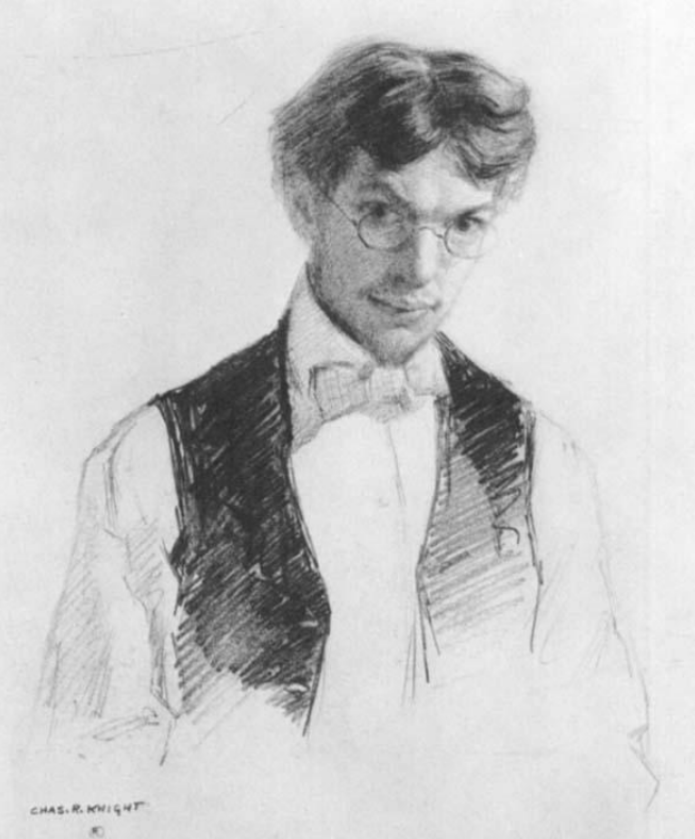
Self-portrait, Charles R. Knight. Published in the Curator: TheMuseum Journal in 1961.
Born in 1874 in Brooklyn, New York, Knight was introduced to nature early, as both his parents had a passion for the outdoors (Knight, 2005). His father encouraged his interest in the natural world by taking him on hikes and fishing trips, and often accompanying him to the American Museum of Natural History (AMNH). From a young age, Knight showed an affinity for drawing, especially animals, and he began sketching at the age of five or six. His early works were often based on illustrations from books, but as he grew older, he realized the importance of drawing from life. By eighteen, Knight had already begun his professional career, having studied at the Metropolitan Art School and working as an illustrator for children’s books and magazines.
Despite his talent, Knight faced significant challenges due to his visual impairment. At six years old, he suffered a corneal injury in his right eye from a stone thrown by a playmate. Additionally, he inherited astigmatism from his father, a condition that causes blurred or distorted vision8. Nevertheless, this did not hinder his passion for art and science. His perseverance and skill led him to become one of the most influential paleoartists of his time.
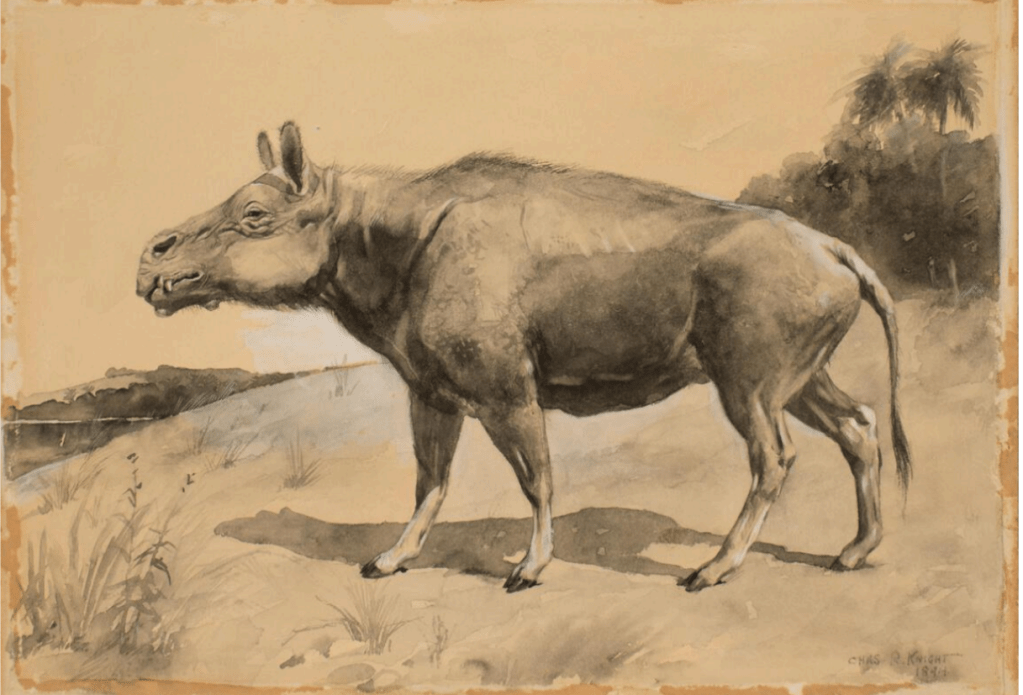
Knight continued to visit the American Museum of Natural History frequently, spending hours in its taxidermy department where he studied animal musculature and skeletal structures. This dedication led to his first major commission in the 1894, the restoration of Elotherium, a pig-like mammal. Knight created a lifelike interpretation of the extinct animal inspired by his knowledge of the anatomy of modern-day pigs. The museum’s scientists were impressed with his work, and this moment marked the beginning of a long collaboration, where Knight would go on to produce numerous iconic depictions of prehistoric life.
“The career of Knight is a nice example of the fact that men make museums and museums make men. It was the artist who gave life to the dead bones, yet it was the museum with its resources of scholars, books,and collections that enabled the artist to interpret the past with the insight of research added to the skill of his hand,” (“The Career of Charles R. Knight,” 1961).
It was at the American Museum of Natural History that Knight met Henry Fairfield Osborn, a pioneering paleontologist, who played a significant role in shaping Knight’s career (“The Career of Charles R. Knight,” 1961). At the time, Osborn was leading the Department of Vertebrate Paleontology with the ambitious goal of making fossils more accessible to the public. Until then, fossils had been kept hidden away for scientific use only (Cain, 2010). Osborn envisioned exhibiting them, and to achieve this, he assembled a team comprising himself, Knight, and Dr. William Diller Matthew, another prominent paleontologist of the time. Together, they worked to mount fossil skeletons in lifelike poses, with Knight playing a crucial role. He sketched the skeletons and used his extensive knowledge of animal musculature to breathe life into the ancient remains.

The museum soon realized that Knight’s watercolor life restorations made the accompanying exhibits more attractive to the visitors. One such restoration was the Leaping Laelaps (1897), which features a dramatic depiction of two dinosaurs in action. One dinosaur is shown falling on its back, while the other leaps on top of it, creating a dynamic and energetic scene. This image was one of the first to suggest that dinosaurs were energetic creatures, challenging the common perception of them as slow-moving and sluggish. Knight’s rendering of dinosaurs with a sense of motion foreshadowed later scientific shifts in paleontology, such as the understanding that dinosaurs may have been warm-blooded and likely related to birds. This shift in perspective is known as the “dinosaur renaissance,” and gained strong support in the 1970s through the work of paleontologists like John Ostrom (1974) and Robert Bakker (1986).
Throughout his career, Knight placed great importance on drawing from life (Knight, 2005). He regularly visited zoos and museums to study animals. He believed that a thorough understanding of anatomy was essential to creating lifelike representations. His partnership with scientists, particularly Osborn and Matthew, ensured that his restorations stayed aligned with the latest paleontological discoveries. More than an artist, Knight was a dedicated student of paleontology, meticulously researching the scientific context behind each painting of extinct animals to ensure accuracy (Scientific American, 1931). His anatomical knowledge allowed him to bring the extinct creatures to life so convincingly that the viewers might have felt he had seen them firsthand. However, while Knight produced intricate studies of living animals’ musculature, the mere skeletons of extinct animals would not allow for extensive knowledge of their musculature (Paul, 1996). Instead, he created dinosaur restorations based on skeletal mounts, rough sculptures, or freehand sketches – a tradition in which many dinosaur artists have followed.

Knight’s influence on paleontological illustration cannot be overstated. He was one of the first to depict dinosaurs as active creatures, and his work dominated the paleoart scene for much of the early 20th century. However, like many of his contemporaries, Knight’s art sometimes reflected the scientific assumptions of his time. For instance, he portrayed dinosaurs with narrow, reptilian thighs in line with the belief that they were slow, cold-blooded animals. This approach persisted for years, even inspiring future artists like Gregory S. Paul. Paul recalls grappling with Knight’s portrayal of dinosaurs, as a young artist in the 1960s (Paul, 1996). While studying dinosaur skeletons, he noticed that their structures seemed to suggest broader, more bird-like hips rather than the narrow, reptilian thighs Knight had painted. Still, he followed Knight’s lead, even though contemporary anatomical studies suggested that dinosaurs likely had more developed musculature. “What was a teenage dino-artist to do? I copied my hero Knight, even though Alfred S. Romer, the esteemed vertebrate paleontologist of Harvard, had correctly depicted big-hipped dinosaurs with broad, birdlike thigh muscles in his classic 1920s studies of the evolution of tetrapod musculature,” noted Paul. Knight’s influence was so strong that it overshadowed emerging anatomical insights, highlighting the lasting impact of his artistic choices on paleoart.
Misconceptions in paleoart might not be as severe as misunderstandings in fields like climate change or medicine, but they still play a significant role in science education. Dinosaurs, for example, are often one of the first scientific topics children encounter, sparking interest in broader areas of science (Ross, Duggan-Haas, & Allmon, 2013). As a subject, dinosaurs are accessible to most, remaining widespread in both educational settings and popular media. Misconceptions in paleoart offer a valuable opportunity to explore how misunderstandings arise through various forms of science communication, whether via illustrations, exhibits, or other media. Furthermore, recent perspectives on misconceptions show that they can be used constructively in building scientific understanding. Misconceptions are often a mix of incorrect ideas and partially accurate knowledge. For example, many people know that T. rex had small front limbs and a long tail, which reflect some accurate concepts. Addressed properly, these misconceptions can provide a foundation for learning more about the true scientific picture.
Knight’s work played a crucial role in popularizing paleontology and bridging the gap between scientific theory and public imagination. These depictions of prehistoric life sparked curiosity and excitement about paleontology, leading the public to engage with new scientific ideas in ways they had never done before, and it was their interpretative nature that conferred a whimsical charm to them: “For my part I strove to impart a life-like appearance to my restoration, certain that at one time the animal I had represented was a moving, breathing creature,” (“The Career of Charles R. Knight,” 1961). Knight’s legacy endures in the lasting influence of his work on museums, textbooks, and media. His dynamic depictions of dinosaurs have continued to shape the way we imagine these ancient creatures, even as new discoveries and technologies have refined our understanding. In the broader context of scientific communication, Knight’s career reminds us that art plays a vital role in making complex subjects like paleontology approachable. By blending scientific knowledge with artistic imagination, Knight created a bridge between the technical world of paleontology and the general public, showing how creativity and science can collaborate to inspire and educate.
Endnotes
- 1. Henry Fairfield Osborn, then president of the American Museum of Natural History, was thefirst to name Tyrannosaurus rex in a 1905 paper. The description of the dinosaur wasaccompanied by the first illustration of the fossil, depicting it in a kangaroo-like posture,upright with its tail on the ground (Osborn, Brown, & Lull, 1905).
- 2. This phenomenon was explored in a 2013 study where students were asked to draw T. rexfrom the memory (Ross, Duggan-Haas, & Allmon, 2013). Regardless of their educationlevel, most of them drew T. rex in the outdated, upright posture, despite a shift in scientificunderstanding since the 1970s (Ostrom, 1974; Bakker, 1986). This revised understandinghas been reflected in updated depictions in both scientific illustrations and popular media,including the 1993 blockbuster Jurassic Park (Box Office Mojo, 2024). This lingeringmisconception could be attributed to the slower adoption of scientifically accurate depictionsin certain areas of popular culture, such as children’s books, cartoons, and toys. Thesemedia are less likely to be revised or regulated, unlike museums or scientific publications.As a result, many people still visualize dinosaurs in ways that science has long sincecorrected.
- 3. Another source recorded twenty-eight guests (Owen, 1894).
- 4. Only four of the Crystal Palace dinosaur models are true dinosaurs (Witton & Michel, 2022).
- 5. This misconception came from early fossil descriptions by Gideon Mantell, a leadingpaleontologist of the time, whose name was displayed on banners during the Iguanodonbanquet, along with the name of other prominent figures of nineteenth-century geology andpaleontology, such as Richard Owen, William Buckland, and George Cuvier (Witton &Michel, 2022). Owen voiced concerns regarding this interpretation, suggesting that the hornwas in fact a large thumb spike. Hawkins followed Mantell’s interpretation, despite Owen’sdoubts of this feature.
- 6. The oldest known, incontrovertible piece of palaeoart was created by Professor JeanHermann of Strasbourg in 1800 – a restoration of a pterosaur (Pterodactylus antiquus) as awinged mammal (Witton, 2018).
- 7. Knight’s granddaughter, Rhoda Knight Kalt, manages a website dedicated to hergrandfather’s legacy. The site features a collection of his works and information about themuseums that continue to display them (Kalt et al., 2002).
- 8. Knight faced significant hardships in his personal life, including the death of his mother at ayoung age and the later loss of his father when Knight was eighteen, prompting him toleave home due to a strained relationship with his stepmother (Knight, 2005).
References
Williams, P. M. (1970). “The Unique Gift of Charles R. Knight.” Bulletin 41(6), 4–6.
“The Career of Charles R. Knight.” (1961). Curator: The Museum Journal, 4(4), 352-367. https://doi.org/10.1111/j.2151-6952.1961.tb01567.x
Allmon, W. D. (2006). The pre-modern history of the post-modern dinosaur: phases and causes in post-Darwinian dinosaur art. Earth Sciences History, 25(1), 5-35.
AMNH Library. (1897). Dryptosaurus (Leaping Laelaps) by Charles R. Knight [Painting]. Art Survey no. 761. Retrieved from https://digitalcollections.amnh.org/archive/Dryptosaurus–Leaping-Laelaps–2URM1THK G7N.html
AMNH Library. (1899). Charles R. Knight working on Stegosaurus sculpture [Photograph]. Image no. 327667. Retrieved from https://www.darwinlive.com 6. Ansón, M., Hernández Fernández, M., & Saura, P. A. (2015). Paleoart: Term and conditions (a survey among paleontologists). In Current Trends in Paleontology and Evolution: XIII Encuentro en Jóvenes Investigadores en Paleontología (XIII EJIP) (pp. 28-34). Retrieved from http://hdl.handle.net/10261/120877
Bakker, R. T. (1986). The dinosaur heresies. William Morrow and Company, Inc. 8.
Berman, J. C. (2003). A note on the paintings of prehistoric ancestors by Charles R. Knight. American anthropologist, 105(1), 143-146.
Box Office Mojo. (2024). Jurassic Park (1993) worldwide box office revenue. Retrieved November 9, 2024, from https://www.boxofficemojo.com/revenue/
Cain, V. (2010). ‘The direct medium of the vision’: Visual education, virtual witnessing and the prehistoric past at the American Museum of Natural History, 1890–1923. Journal of Visual Culture, 9(3), 284–303. https://doi.org/10.1177/1470412910380334
Debus, A. G., & Debus, D. E. (2002). Paleoimagery: The evolution of dinosaurs in art. McFarland & Company, Inc., Publishers.
Kalt, R. K., Hannotte, D., Kennett, C., & others. (2002, October 6). Charles R. Knight: Artist and natural history illustrator. http://www.charlesrknight.com
Knight, C. R. (1894). Entelodon (formerly Elotherium) [Illustration]. AMNH Special Collections, RF-89-C. https://digitalcollections.amnh.org/archive/Entelodon–formerly-Elotherium-2URM1THAZ YV.html
Knight, C. R. (2005). Charles R. Knight: Autobiography of an artist. Gt Labs. 15. Milner, R. (2012). Charles R. Knight: The artist who saw through time (p. 180). New York: Abrams.
Milner, R. (2012). Time traveler. Scientific American, 306(4), 70–73. http://www.jstor.org/stable/26014329
Natural History Museum. (2017, July 13). Museum unveils Hope the blue whale skeleton. Natural History Museum. https://www.nhm.ac.uk/discover/news/2017/july/museum-unveils-hope-the-blue-whale-sk eleton.html
Natural History Museum. (n.d.). Hintze Hall. Natural History Museum. https://www.nhm.ac.uk/business-services/venue-hire/venues/hintze-hall.html
Natural History Museum. (n.d.). New Year’s Eve. Natural History Museum. https://www.nhm.ac.uk/events/new-years-eve.html
Osborn, H. F., Brown, B., & Lull, R. S. (1905). Article XIV – Tyrannosaurus and other Cretaceous carnivorous dinosaurs. Bulletin of the American Museum of Natural History, 21(259-265).
https://archive.org/details/bulletin-american-museum-natural-history-21-259-265 Ostrom, J. H. (1974). Archaeopteryx and the origin of flight. The Quarterly Review of Biology, 49(1), 27-47.
Owen, R. (1894). The life of Richard Owen (Vol. 1). J. Murray. https://www.biodiversitylibrary.org/page/41508304
Paul, G. S. (1996). The Art of Charles R. Knight. Scientific American, 274(6), 86-93.
Rieppel, L. (2012). Bringing dinosaurs back to life: Exhibiting prehistory at the American Museum of Natural History. Isis, 103(3), 460-490.
R. M., Duggan-Haas, D., & Allmon, W. D. (2013). The posture of Tyrannosaurus rex: Why do student views lag behind the science? Journal of Geoscience Education, 61(1), 145–160. https://doi.org/10.5408/12-377C
Scientific American. (1931). Extinct because of too much evolution. Scientific American, 144(3), 152. https://www.jstor.org/stable/10.2307/24975581
Taquet, P., & Padian, K. (2004). The earliest known restoration of a pterosaur and the philosophical origins of Cuvier’s Ossemens Fossiles. Comptes Rendus Palevol, 3(2), 157-175.
Testa, R. (Photographer). (1980). T. rex and Triceratops [Photograph]. Field Museum of Natural History. https://mm.fieldmuseum.org/bd850db6-9190-4628-be33-b7a500dd7338 (Accessed July 10, 2024)
The Illustrated London News. (1854, January 7). The Illustrated London News, 24(662), 22. Retrieved from https://archive.org/details/IA1642421-03
Witton, M. (2018, May 5). Iguanodon bernissartensis restoration. Mark Witton’s Blog. https://markwitton-com.blogspot.com/2019/05/
Witton, M. P. (2018). The palaeoartist’s handbook: Recreating prehistoric animals in art. The Crowood Press Ltd.
Witton, M. P. (2020). Life Through the Ages II: Twenty-first Century Visions of Prehistory. Indiana University Press.
Witton, M. P., & Michel, E. (2022). The art and science of the Crystal Palace dinosaurs. The Crowood Press Ltd.
Wright, I. (2014, August 2). Dinosaurs in Crystal Palace Park [Photograph]. Flickr. https://www.flickr.com/photos/randomlylondon/15811400132
 Bridging Science