
By Michelle Brad
This article was written for the course History and Philosophy of Science 2025.
Introduction
In 2003, Willem Alexander, crown prince of the Netherlands, was surprised by a change in the program of his state visit to Saint Petersburg. One particular point on the agenda was cancelled: The anatomical collection of the Dutch anatomist Frederik Ruysch (1638-1731). The various anatomical preparations, including that of embryos and small children, were not considered to be appropriate for him and his pregnant wife.1
The cancellation illustrates how Ruysch’s anatomical collection is nowadays mostly considered a rather morbid display. It makes one wonder who Frederik Ruysch was and how his anatomical collection was viewed during his own time by the public and influential people alike. I attempt to answer these questions in this essay by first elaborating on the time of Ruysch, what inspired him to start collecting, and what this collection eventually consisted of. I will present several responses to his collection from a variety of people and I will also show how Ruysch himself thought his collection might be received. I will argue that most of the responses from others make sense in the historical context when considering the attitude towards death and anatomy in the late seventeenth and early eighteenth century. Lastly, I will argue why women, particularly when pregnant, might not have been included in the visits.
The time of Frederik Ruysch
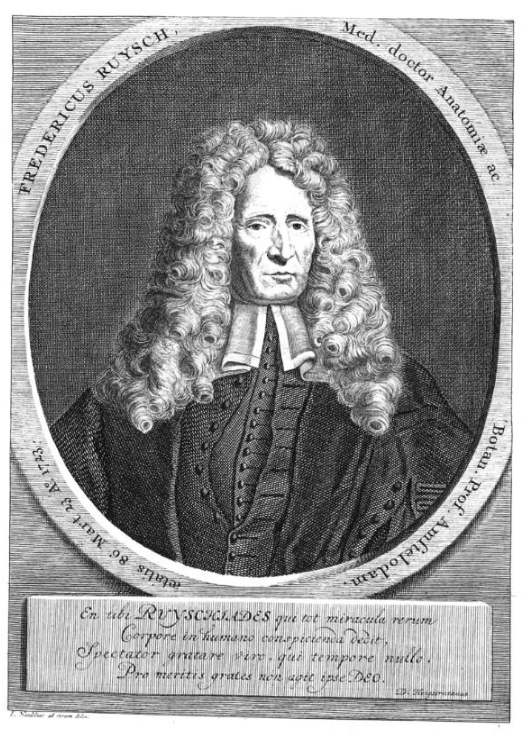
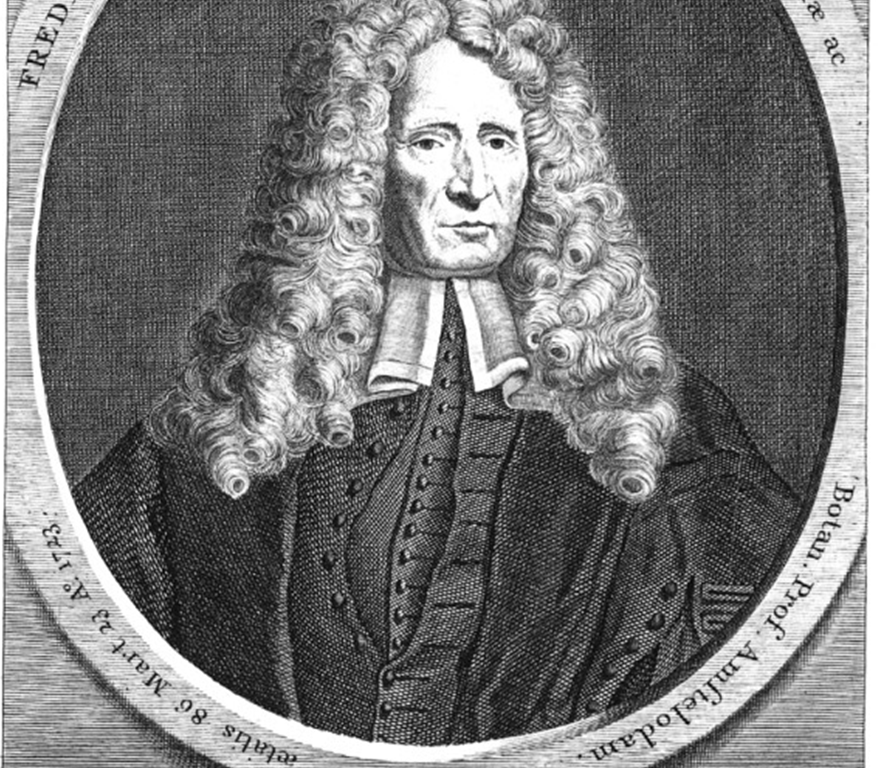
Ruysch (fig 1) grew up during the Golden Age in the Netherlands. Trading merchants brought much economic wealth to the country, allowing the Dutch to send many expeditions around the world to discover unknown territories. The explorers brought back many mysterious items, plants and animals from faraway places. These discoveries were shared with the world young Ruysch lived in, and likely fascinated him greatly. He truly came in contact with newly discovered herbs and plants when he started his apprenticeship as an apothecary. Ruysch began to collect plants from his direct environments himself. Soon afterwards, he started collecting other natural specimens, including human remains, a preview to what was to come.
During the Golden Age, The Netherlands did not just thrive economically. The medical field was one that underwent immense advancements as well. People started to realize that their knowledge on the inner workings of the human body was limited, resulting in dissections to extend their knowledge. At first, animals were used to gain knowledge to avoid dissecting the human body itself.
After receiving his apothecary degree in 1661 and opening his own store, Ruysch decided to follow anatomy classes in Leiden to satisfy his own growing interest in anatomy.2 He was limited to studying anatomy in animals as well and was even encouraged by one of his teachers to strangle dogs to practice on. However, the need for anatomical knowledge that was not based on animals grew and eventually resulted in the use of human bodies. Nevertheless, Galen’s theory of the four humours3 still dominated the field of anatomy, and dissection of the human body was initially solely used to increase understanding of the written texts rather than to answer questions. Steadily though, explanations for the observations that could not be explained with Galen’s theory ran dry, so human bodies were used to find other explanations.4 Ruysch also realized that the theories at hand did not always align with his observations.5
With the growing use of bodies for dissection, the need for preserving them became more urgent for several reasons. One only had limited time until a body would start to smell and much of the color variation and detail would be lost. Since Ruysch’s goal became to reveal the anatomy of the human body as it is, he started to make attempts at preservation, but kept his technique secret. Eventually, he managed to create a technique that would preserve his specimens for centuries to come.6
Museum Anatomicum Ruyschianum
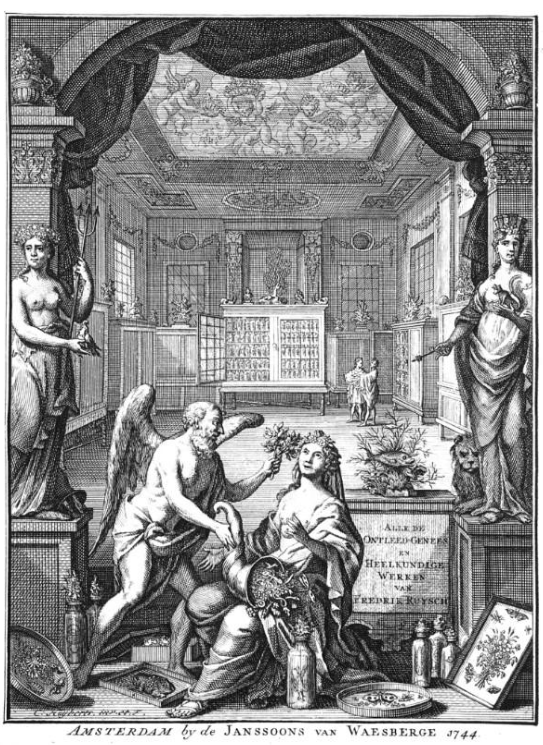
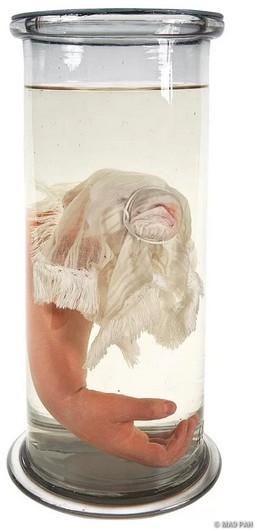
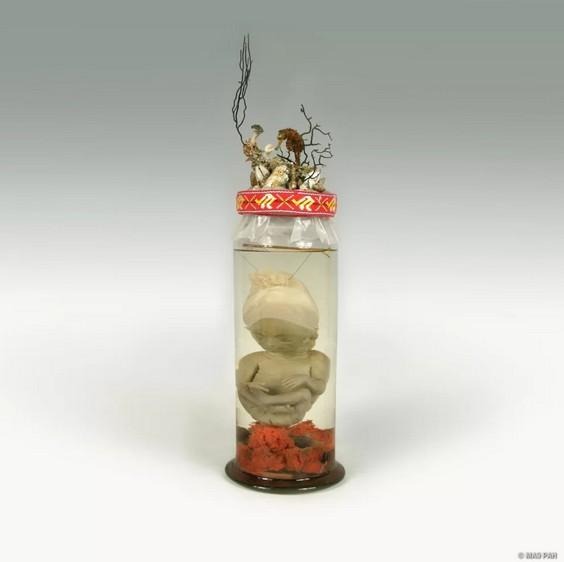
Ruysch opened his museum (fig 2) in 1689, located in his house on the Bloemgracht in Amsterdam.7 At this point, Ruysch’s collection had grown considerably and included many of his own preserved anatomical specimens. He wrote an extensive work that included descriptions of all twelve of the cabinets.8 However, the collection was far from organized by specific themes. He mixed both human and animal body parts; adults and children or fetuses; and dry and wet material (fig 3). At times, he would decorate his pieces with flowers, lace or other materials (fig 4).
Although this essay focuses on the anatomical collection, Ruysch’s collection consisted of much more than that. He also displayed plants, his original topic of fascination, as well as insects, herbs, sea creatures and shells.9
He encouraged all to come and see with their own eyes, since Ruysch trusted only his own eyes and observations to reveal the truth.10 Many people from different countries and social backgrounds therefore visited the collection displayed in his house. This included commoners, who often had to pay to see an array of jars with anatomical specimens. Among the more esteemed visitors were fellow physicians and people from higher social classes, who he often guided through the museum himself. One of the most prestigious visitors was Tsar Peter the Great, who was fascinated by the collection and later bought it.11
Interest in the collection
It seems that his museum was a popular attraction, but this does not necessarily imply that people accepted and appreciated his work. Although there were people in his field who had critiques,12 this was mostly related to his anatomical findings rather than his unusual presentation of specimens. This essay focuses on the praise he received, since the abundance of it shows that the collection was admired not just by a rare few. Even though the sources might be biased, since much of it is published in his collected works, it is – in a sense – representative of how his collection was received by at least part of the public.
When consulting the two guestbooks Ruysch kept for his visitors to sign, one can see that many physicians visited the home of this famous anatomist, their interest likely arising from a professional viewpoint. In Latin, these ‘colleagues’ of Ruysch show their appreciation for his skill.13
In the published correspondences, physician Johannes Gaubius does the same: “How neat and artistic we could see the veins of the whole body undamaged and in their entirety. The limbs, although stiff and hard, are flexible. On top of that, you have shown the intestines, which would otherwise be subject to decay, clean, unspoiled and pleasant to look upon, which seems almost impossible”.14 Other letters show how much of a name Ruysch had made for himself. Gaubius wondered “who would not be amazed by this unusual display of a dead body” and mentioned Ruysch’s achievement in attracting many visitors who, according to Gaubius, would only applaud his work.15 Furthermore, physician Gerardus Frentz comments on the originality of the collection: “I have visited Spain, France, Holland and other countries, but nowhere, not even in my home country, have I seen something like it.” He, like various others, observes the lack of decay in Ruysch’s specimens, setting his work apart from others in the field.16
Not only fellow physicians wrote about their experiences visiting the museum. Élie Richard, a French huguenot interested in science, wrote an extensive travelling journal in which he described visits to physicians and their curiosity cabinets in several countries. He observed that one of the specimens he saw at Ruysch’s museum still looked as if it were alive. The only part of the specimen that looked artificial to Richard were the eyes.17
Even people from the highest social classes were welcomed. When Ruysch writes a letter to physician Herman Boerhaave, he describes how a certain European monarch hugged and kissed the specimen of the head of a boy, most likely referring to the Russian Tsar.18
These responses are only a small selection, but clearly illustrate how much Ruysch was admired by different people.
Besides other people’s opinions on Ruysch’s collection, it is interesting to look at Ruysch’s own view on the collection and how he thought people would receive it. Although his books contain mostly anatomical descriptions,19 the introduction to the various parts of his books contain some hints.
In his work, he repeatedly praises the results of his preparation method, calling the preparations “artistic” and “natural-looking”, which is in line with the comments he received from others. Ruysch realizes that death changes the body (“It is more than known that everything about humans that is pleasant to the eye is robbed by death.”), but it is clear that he believes he has mastered the ability to restore most of this beauty again (“With the discovered art, the natural state of the diseased body is revived, so that it can not be distinguished from a living, sleeping human.”) On top of that, he repeatedly praises the lack of stench coming from his specimens: “The dead give off a rather unpleasant smell. On the contrary, these are pleasant of smell.”, highlighting what others have noted as well.20
Besides his own appreciation, he does briefly mention his opinions on how the general public might respond to his cabinet, especially when it comes to parents and pregnant women. He describes a case of a baby who was born with a cleft lip, emphasizing on the unnatural look. He mentions that he would not show these specimens – or others like it – to anyone, unless they would specifically ask for it. He fears his affairs would cause fright or disgust otherwise.21
When being asked why he decorates his preparations, he says: “I do it to relieve humans of all aversion, who are commonly so frightened of dead bodies and her parts. Secondly, I do it for the honor and dignity of the soul that was once in it. Therefore, I have faith that I am not committing sin with her graceful finery.”22 So Ruysch was aware of how the look of a dead body might come across and used decorations meant to soften the look of death and make it more pleasant to the eye.23
Perspective on death and anatomy at the turn of the century
Based on the various sources, it can be said that many were fascinated, rather than horrified by what Ruysch was showing them, even though Ruysch himself seemed to have a few concerns about how certain specimens might appear to others. To understand this response, it is important to consider the historical context, especially the perspective on death in the early modern period.
Ruysch opened his museum at the end of the seventeenth century. Many of the customs and ideas about death in this period were dictated by religion and were carried over from medieval times. One of these ideas was the concept of memento mori, or ‘remember you must die’. It reminded people of their own mortality and the fact that life only existed for a short period of time.24Ruysch’s inscriptions accompanying several of his specimens, such as “The life of humans hangs on a silk string”25 and “The rich as well as the poor cannot escape death”26, are clear examples of the influence of the memento mori theme. His displays encouraged people to do good during their lifetime, since that would assure a place in heaven. Keeping in mind memento mori and preparing for the afterlife during one’s lifetime was a practice called The Good Death. If you had lived a good life and were well prepared for what comes after, death was not something to be feared and was sometimes even anticipated, although not to be rushed.27 This attitude towards death likely influenced the positive receival of the collection greatly.
Another belief carried over from medieval times to the Golden Age was the concept of Original Sin. When the physical body started decomposing, this decay was commonly believed to be the expression of spiritual corruption, which was considered inherent in all humans and derived from Original Sin.28 In the eighteenth century, Jean-Jacques Rousseau would propose his theory on the innocence of childhood29, but in the seventeenth century this idea had not been formed yet. However, in 1689, the same year Ruysch opened his museum, John Locke published his work titled ‘An Essay Concerning Human Understanding’. He proposed that children were born with a ‘clean slate’ and learned most things after birth through perception and experiences.30 This indirectly implied that corruption occurred only later in life. Ruysch managed to preserve the bodies he collected perfectly, as if they had not been corrupted in the first place. Many of Ruysch’s preparations were of small children and fetuses, and although not seen as innocent yet, people were slowly rejecting the idea of Original sin. Therefore, I argue that the idea of forever conserving this state unaffected by corruption was likely becoming more appealing.
The decoration of many of the severed limbs, although not necessarily for the sake of making art, but rather to soften the look of death, probably attributed as well. Ruysch himself refers to death as robbing the living of their beauty, yet he tries to preserve this beauty, therefore making death a thing of beauty in itself. Death – perhaps unintentionally – becomes art. Thus, the decorations and lack of decay, combined with the memento mori theme, presumably increased the allure of the collection.
However, with the practice of anatomical dissection on the rise, people started to worry that their own or their loved ones’ bodies would end up being used for dissection or displayed in a collection. Since proper burial was important in order to make the body comfortable for life after death, the idea of a body being removed from this place of comfort was unacceptable. Even so, this fear started to appear in society around the eighteenth century.31 Considering the fact that people still decided to visit his museum, this fear might not have been fully developed yet during the years it was open. Especially his fellow colleagues, who visited his museum often and were in many cases involved in dissection practices themselves, probably did not fear this as much as the general public might have.
Maternal imagination theory
As mentioned before, Ruysch suggested that not all preparations were appropriate for everyone to see. In the case of the baby with the cleft lip, he wonders whether the body of the fetus had been destroyed by fright or by witnessing something else that caused the deformation. Yet he prefers to only describe his cases and does not want to explicitly express his opinions on this idea.32 The description is in line with the maternal imagination theory, which suggests that simply looking at or experiencing something unpleasant – such as the body of a deformed fetus – could make a woman’s imagination run wild, resulting in a deformed fetus.33 For this reason, women, especially when pregnant, were likely excluded from visiting the museum. When going through the guestbooks, it is noticeable that the books are almost exclusively signed by men, with a few exceptions.34 It could be that women truly did not visit the museum often, based on their own judgement or that of the men surrounding them, but perhaps they simply did not sign the guestbook. However, the maternal imagination theory is a possible explanation for the lack of female presence.35
Conclusion
I have argued why Frederik Ruysch’s anatomical collection was visited and admired by so many during his time. I started by describing Ruysch’s time, what inspired him and how he eventually came to develop a unique preservation technique. By showing a selection of quotes from people with different social backgrounds, I aimed to illustrate the popularity of the collection and fascination for Ruysch’s skill. His own view shows another side to how his work could have been received, since even Ruysch was hesitant to show all he owned and was selective in who he would show which pieces. The presence of the memento mori theme, the softening, uncorrupted look he gave death with his unmatched preservation skills, as well as the not yet fully developed fear towards anatomy likely contributed immensely to his popularity. Even so, certain parts of society, in particular (pregnant) women, were probably excluded from viewing his work, in which the maternal imagination theory could have played a role.
Throughout the ages, the receival of the anatomical collection of Frederik Ruysch has varied from appraisal to horror. It has attracted many, yet also excluded certain parties from visiting, which even continues into the twenty-first century with the exclusion of the now queen of the Netherlands.
Footnotes
- Van Zwol, ‘Bezoek St. Petersburg zit vol angels’. https://www.nrc.nl/nieuws/2003/09/24/bezoek-st-petersburg-zit-vol-angels-7655213-a40283. ↩︎
- Kooijmans, De doodskunstenaar, 1–20; Muller, Onze Gouden Eeuw; See also: Ruysch, Alle de ontleed- genees- en heelkundige werken, 661. One of his pupils, Joannes Fridericus Schreiberus, wrote the introduction to Ruysch’s works, which were published in 1744, thirteen years after his death. Although perhaps exaggerated, Scheriberus describes Ruysch’s travel to Leiden and perseverance in following his passion as the following: “He turned towards a tougher way of life, drinking water from the riverbank with his hat to lessen his thirst, exhausted from walking through dry, sandy places, while other apothecary students, his friends, would rather taste the sweet wine in the nearest inn.” This determination showed in other ways as well. Since Ruysch did not live in Leiden itself, he had to wake up during the night in order to attend classes early in the morning. ↩︎
- See also: Stelmack and Stalikas, ‘Galen and the Humour Theory of Temperament’. The body was thought to consist of four humors: black bile, yellow bile, phlegm and blood. Either an abundance or deficiency of one or more of these humors was thought to cause illness. ↩︎
- Lindeboom, Geschiedenis van de medische wetenschap in Nederland, 32-34. The dissections that were held to answer these questions were often done in public. Not only doctors, but large numbers of the general public attended as well, eager to take a peek into the, before then, hidden and unknown. Leiden also had one of these dissecting theaters, which originated in 1597. Leiden University created an anatomical collection soon after, which could be visited by the general public as well; See also: Jorink and Ramakers, ‘Undivided Territory’. The knowledge gathered in dissecting theaters was not only useful for doctors, but for artists as well, showing that art and science were closely related at the time; Kooijmans, De doodskunstenaar, 11. ↩︎
- Kooijmans, De doodskunstenaar, 15–16; See also: Kooijmans, De doodskunstenaar, 15, 334, 348–52. During his studies, Ruysch, together with many others, convinced people to bring him to the graveyard to acquire bodies for dissection. Later, Ruysch, together with his son Hendrik, would be responsible for the education of midwives. This connection allowed him to acquire many specimens for dissection, particularly of fetuses and babies. ↩︎
- Kooijmans, De doodskunstenaar, 44–46, 444–47. ↩︎
- Kooijmans, De doodskunstenaar, 169; See also: Knoeff, ‘Touching Anatomy’. Although Ruysch’s collection was called a museum, this is different from the museum we are used to nowadays. Many of his preparations were used as working material, enabling him to show visitors details continuously and for the visitors to interact hands-on with the material. ↩︎
- Ruysch, Alle de ontleed- genees- en heelkundige werken, 660; See also: Margócsy, ‘Advertising Cadavers in the Republic of Letters’. In his collected works, Ruysch not only describes his collection, but he also promotes his work and announces public dissections, something that was done more often by others as well. ↩︎
- Ruysch, Alle de ontleed- genees- en heelkundige werken. ↩︎
- Ruysch, Alle de ontleed- genees- en heelkundige werken, 524, 696, 852, 1244. ↩︎
- Kooijmans, De doodskunstenaar, 236–45; See also correspondences from various people who visited in: Ruysch, Alle de ontleed- genees- en heelkundige werken; Ruysch and University of Amsterdam, ‘Visitors’ Book of Frederik Ruysch: Manuscript’. ↩︎
- See various correspondences in Ruysch, Alle de ontleed- genees- en heelkundige werken; See also: Ruysch, Alle de ontleed- genees- en heelkundige werken, 1095. Ruysch writes that a certain professor even told him to stop revealing any new information based on his observations and to keep to what has been assumed to be the truth for many centuries, referring to the work of Galen. ↩︎
- Ruysch and University of Amsterdam, ‘Visitors’ Book of Frederik Ruysch: Manuscript’. ↩︎
- Ruysch, Alle de ontleed- genees- en heelkundige werken, 228. ↩︎
- Ruysch, Alle de ontleed- genees- en heelkundige werken, 227. ↩︎
- Ruysch, Alle de ontleed- genees- en heelkundige werken, 267. ↩︎
- Richard, Door ballingen onthaald, 185–86. ↩︎
- Ruysch, Alle de ontleed- genees- en heelkundige werken, 1222. ↩︎
- For example: Ruysch, Alle de ontleed- genees- en heelkundige werken, 875. “A jar with fluid and within the shank or leg of a freshly born child, with the foot, vividly displayed; holding between the toes a branch of Granadilla with a three-pointed leaf and a small yellow flower of Tournefort, of which the flower is yet undamaged”. ↩︎
- Ruysch, Alle de ontleed- genees- en heelkundige werken, 661. That his works were a way of promoting his material to potential buyers is illustrated again in the way Ruysch describes his specimens. ↩︎
- Ruysch, Alle de ontleed- genees- en heelkundige werken, 691. ↩︎
- Ruysch, Alle de ontleed- genees- en heelkundige werken, 1100, 819. ↩︎
- See also: Ruysch, Alle de ontleed- genees- en heelkundige werken, 495, 532, 549, 660, 1095. Ruysch had been accused of using paint to make his specimens look more ‘alive’. He himself seemed to think he had to emphasize that he did not paint his specimens. He even wondered how anyone could paint all the details visible in his preparations, since there were simply so many. ↩︎
- Clarke, ‘Memento Mori’; See also: Clarke, ‘Vanitas’. In the Netherlands, incorporating memento mori into still-life art pieces, or vanitas, was common in the seventeenth century. ↩︎
- Ruysch, Alle de ontleed- genees- en heelkundige werken, 155. ↩︎
- Ruysch, Alle de ontleed- genees- en heelkundige werken, 180. ↩︎
- Klestinec and Manning, ‘The Good Death in Early Modern Europe’; Binski, Medieval Death, 33–47. ↩︎
- Juan, ‘The Turn of the Skull’, 971; Binski, Medieval Death, 36–37. ↩︎
- Rousseau, Emilius; or, A Treatise of Education. Contrary to the concept of original sin, Rousseau proposed that children are inherently innocent and pure, only corrupted by the experiences they have while growing up. He thought childhood was a stage in which the child should be protected. ↩︎
- Locke, An Essay Concerning Human Understanding. Although there are similarities between Locke and Rousseau’s theories, they differ significantly when considering the practical implications. Locke believed a child could and should be properly shaped by education, whereas Rousseau believed children should be protected from society and its corruption. ↩︎
- Bowdler and Balme, ‘“Memento Mori”’. ↩︎
- Ruysch, Alle de ontleed- genees- en heelkundige werken, 691–92. ↩︎
- See also: Ruysch, Alle de ontleed- genees- en heelkundige werken, 1022-1023. The maternal imagination theory essentially puts the blame on mothers, but Ruysch seems to avoid doing that, as is seen in another case of a miscarriage, in which the fetus is severely deformed. He reassures them, since they are afraid they brought forth an abomination; Gordon and Marshall, The Place of the Dead, 289. ↩︎
- Ruysch and University of Amsterdam, ‘Visitors’ Book of Frederik Ruysch: Manuscript’. ↩︎
- Van Zwol, ‘Bezoek St. Petersburg zit vol angels’. Even though the maternal imagination theory has long been rejected, we still seem to think that at least some of the preparations might be considered sensitive for certain people, as is clear from the withdrawal of Willem Alexander’s visit to the collection in Saint Petersburg. Whether they thought it was unfit for a royal is unclear, but it was definitely not considered appropriate for Alexander’s pregnant wife. ↩︎
Bibliography
Binski, Paul. Medieval Death: Ritual and Representation. British Museum Press, 1996.
Bowdler, Sandra, and Jane Balme. ‘“Memento Mori”: Love/Fear of and for the Dead — Archaeological Approaches’. In Early European Research, edited by Michael Champion and Andrew Lynch, vol. 8. Brepols Publishers, 2015. https://doi.org/10.1484/M.EER-EB.5.105233.
Clarke, Michael. ‘Memento Mori’. In The Concise Oxford Dictionary of Art Terms. Oxford University Press, 2010. https://www.oxfordreference.com/display/10.1093/acref/9780199569922.001.0001/acref-97801 99569922-e-1864.
Clarke, Michael. ‘Vanitas’. In The Concise Oxford Dictionary of Art Terms. Oxford University Press, 2010. https://www.oxfordreference.com/display/10.1093/acref/9780199569922.001.0001/acref-97801 99569922-e-1731.
Gordon, Bruce, and Peter Marshall, eds. The Place of the Dead: Death and Remembrance in Late Medieval and Early Modern Europe. Cambridge University Press, 2000.
Jorink, Eric, and Bart Ramakers. ‘Undivided Territory: “Art” and “Science” in the Early Modern Netherlands’. Nederlands Kunsthistorisch Jaarboek (NKJ) / Netherlands Yearbook for History of Art 61 (2011): 6–32.
Juan, Rose Marie San. ‘The Turn of the Skull: Andreas Vesalius and the Early Modern Memento Mori’. Art History 35, no. 5 (2012): 958–75. https://doi.org/10.1111/j.1467-8365.2012.00932.x.
Klestinec, Cynthia, and Gideon Manning. ‘The Good Death in Early Modern Europe’. History Compass 22, no. 8 (2024): e12819. https://doi.org/10.1111/hic3.12819.
Knoeff, Rina. ‘Touching Anatomy: On the Handling of Preparations in the Anatomical Cabinets of Frederik Ruysch (1638–1731)’. Studies in History and Philosophy of Science Part C: Studies in History and Philosophy of Biological and Biomedical Sciences 49 (2015): 32–44. https://doi.org/10.1016/j.shpsc.2014.11.002.
Kooijmans, Luuc. De doodskunstenaar: De anatomische lessen van Frederik Ruysch. Uitgeverij Bert Bakker, 2004.
Lindeboom, Gerrit Arie. Geschiedenis van de medische wetenschap in Nederland. 2nd edn.
Fibula-Van Dishoeck, 1981.
Locke, John. An Essay Concerning Human Understanding. In Four Books. Written by John Locke, Gent 7th edn. Vol. 1. London : printed for J. Churchill, at the Black-Swan in
Pater-Noster-Row; and Samuel Manship, at the Ship in Cornhill, 1715-16., 1715.
Margócsy, Dániel. ‘Advertising Cadavers in the Republic of Letters: Anatomical Publications in the Early Modern Netherlands’. The British Journal for the History of Science 42, no. 2 (2009): 187–210.
Muller, Pieter Lodewijk. Onze Gouden Eeuw: De Republiek Der Vereenigde Nederlanden in Haar Bloeitijd. A.W. Sijthoff, 1896. https://catalog.hathitrust.org/Record/008377005.
Richard, Élie. Door ballingen onthaald: verslag van reizen in Frankrijk, Vlaanderen, Nederland en Duitsland 1708. Translated by Robert den Does. Uitgeverij Vantilt, 2012.
Rousseau, Jean-Jacques. Emilius; or, A Treatise of Education: Translated from the French of J.J. Rousseau, Citizen of Geneva. In Three Volumes. 3 vols. Printed for J. Dickson and C. Elliot, 1773.
Ruysch, Fredericus. Alle de ontleed- genees- en heelkundige werken. Janssoons van Waesberge, 1744. https://www-dbnl-org.proxy-ub.rug.nl/tekst/ruys009alle01_01/index.php.
Ruysch, Fredericus, and University of Amsterdam. ‘Visitors’ Book of Frederik Ruysch: Manuscript’.
Amsterdam, 1695. Allard Pierson – The Collections of the University of Amsterdam.
Stelmack, Robert M., and Anastasios Stalikas. ‘Galen and the Humour Theory of Temperament’.
Personality and Individual Differences 12, no. 3 (1991): 255–63. https://doi.org/10.1016/0191-8869(91)90111-N.
Zwol, Coen van. ‘Bezoek St. Petersburg zit vol angels’. NRC, 24 September 2003. https://www.nrc.nl/nieuws/2003/09/24/bezoek-st-petersburg-zit-vol-angels 7655213-a40283.
 Bridging Science