
Student Podcast on Spotify
by Beatriz Reis
Science Podcasts
Podcasts started over 20 years ago, with the term being coined in 2004 by Ben Hammersley for an article for the Guardian. Podcasts’ production has since been on the rise (although it suffered a dip after the boom of new shows during COVID-19 pandemic), but the amount of podcast listeners continues to increase. According to a 2023 article by Rachl Aroesti in the Guardian, podcasts have turned pop culture upside down in countless unexpected ways – from refashioning comedy to creating “storytelling fuel” for drama and documentary. Podcasts have revolutionised cultural conversations, political discussions and also science communication. Pretty much from the start, science podcasts were there, explaining and exploring scientific topics with the freedom to combine science with humour and entertainment. For example, Radiolab has been around since the early 2000’s and remains one of the top listened to shows on platforms such as Apple podcast. Nowadays there are hundreds of science podcasts in English, most of them targeted at the general public and a few make it far up the charts (“The Rest is Science” is top 20 on Apple podcasts in the UK).
Nature of Scientific Disciplines
Keeping up with the times, SEC Master’s students script, record and edit their own podcast episodes as part of the course Nature of Scientific Disciplines (NSD). Having podcast episodes as final assignments gives students the opportunity to explore what is to many a new format, to make use of the state of the art audio-visual equipment at the faculty and have fun! For the podcast assignment, students are divided into groups and explore a scientific discipline other than the one they have a background in. For example, I have a Bachelor’s in Physics and I was assigned to a group that dove into Biology. The intention behind this is to practice understanding and communicating about research in any scientific discipline to non-experts. This is relevant because as science communicators, we’ll find ourselves communicating about topics that are not in the area we are trained in – being able to grasp the essence and be critical of key aspects of research such as the methods used, how data is analysed and the conclusions presented, are essential for our future careers. The NSD course starts with learning (or revisiting) those skills: how to read a scientific paper, how different methodologies work, what are the models of the nature of science. Putting these skills into practice, each group reads a scientific paper from a discipline other than the own they have a background in and prepare to interview one of the authors. Then, after receiving some guidance on how to make a podcast, it’s time to cook an episode: script writing, recording, editing, repeating (because the first try solemnly ever goes well), and a podcast episode on a scientific discipline is done! But it doesn’t stop there, each group produces a second episode on relevant subjects to science such as ethics, open science and the relationship between science and society. These are more reflective episodes, in which students share their thoughts and those of the researchers interviewed on important aspects of scientific research. All the episodes are later released on Spotify.
Science In & Out
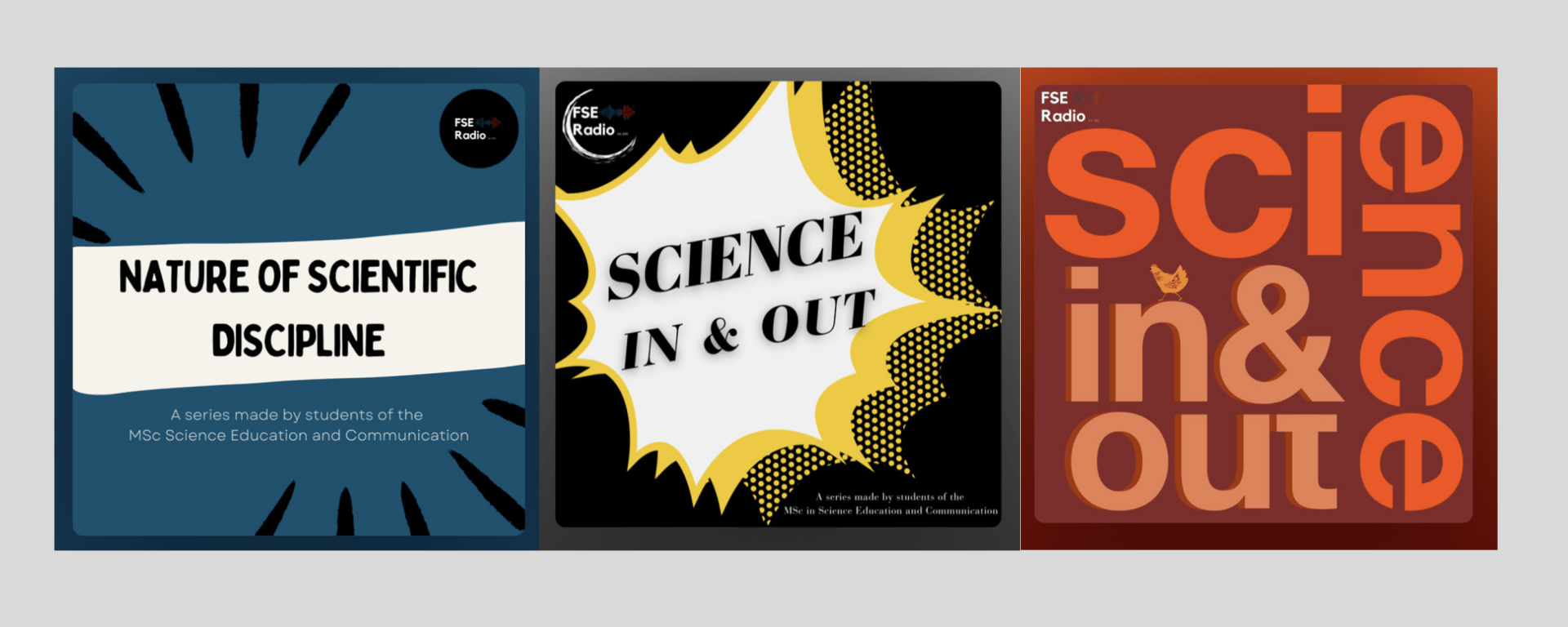
Titled “Science In & Out”, the podcast series comprised of the episodes produced for NSD, is in its third season. Each season varies in length since depending on the amount of students taking the course that year, but no scientific topic is repeated – ranging from phononic metamaterials to agroecology there are currently 11 episodes on scientific disciplines in total. The covers for each season are all distinct and created by the students, giving each of them a unique identity. All episodes can be found on the FSE Radio podcast on Spotify.
Note: the first season had a different name, “Nature of Scientific Disciples”.
 Bridging Science