
This article was written for the course History and Philosophy of Science 2024.
Caterina Sforza: the Tigress of Forlì and the art of alchemy
by Lauren Filarski
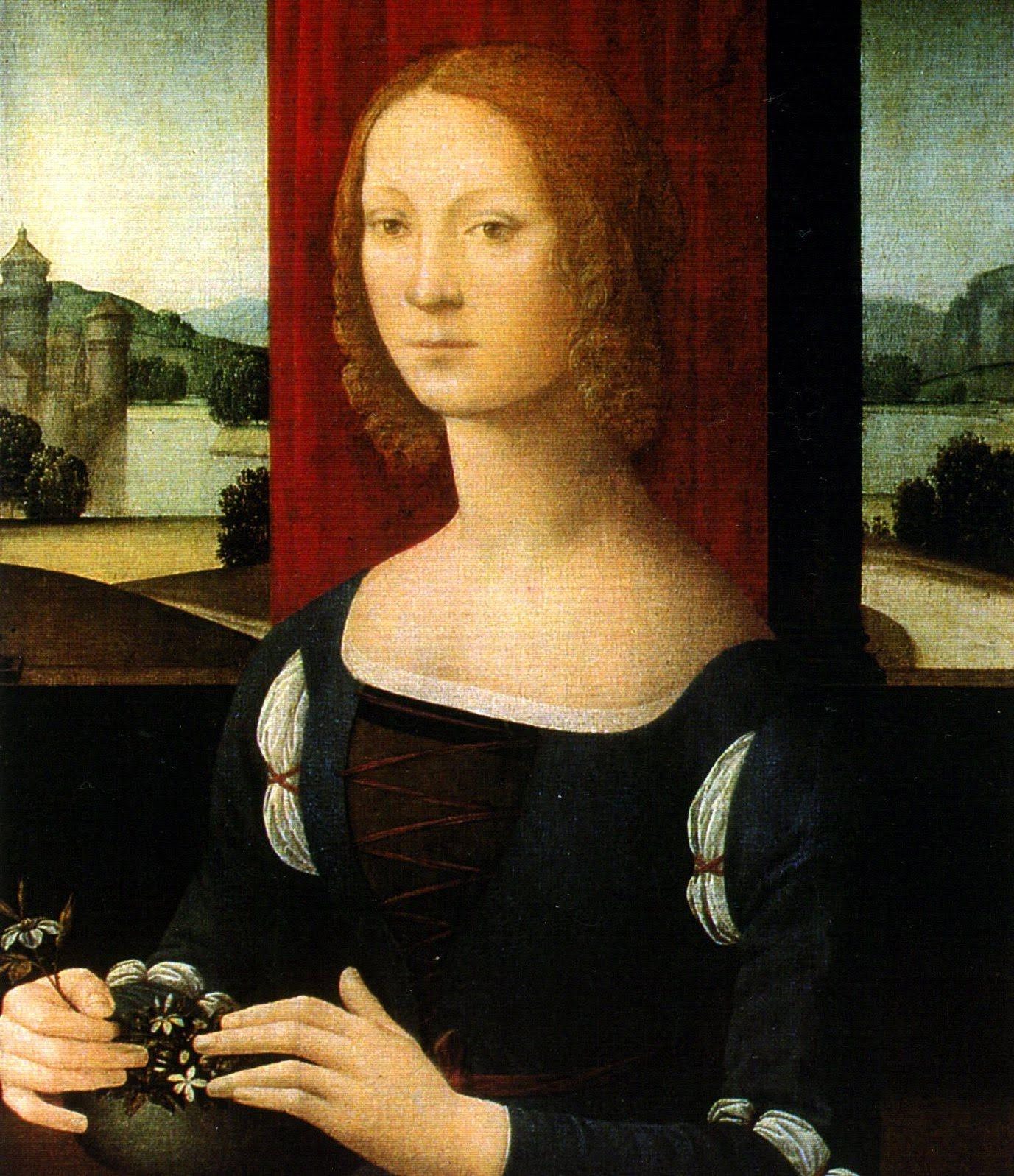
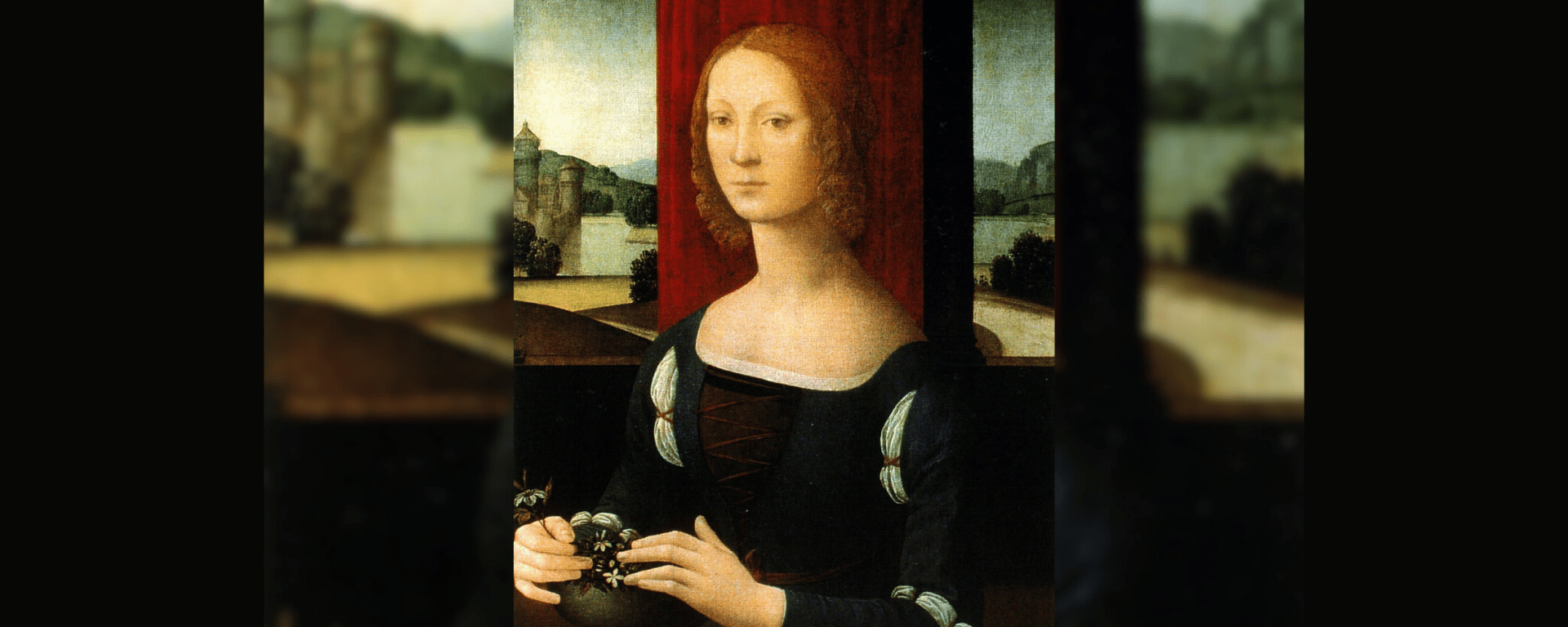
An unexpected power play
Standing on the wall of the fortress, Caterina Sforza lifted her skirts to show her genitals to her captors while stating she had the means to produce more children2. This is how Machiavelli, arguably the most famous humanist of the Italian Renaissance, portrays the capture of Caterina and her children and how Caterina earned the title ‘Tigress of Forlì’.
Her husband, Count Girolamo Riario of Imola and Forlì, was murdered in April 1488 after having drastically increased taxes3. Following his assassination, the conspirators took Caterina and her children as hostages, pressing the Castellan Tommaso Feo to surrender the Riario fortress for their lives. Tommaso held steadfast while Caterina convinced her captors that she would negotiate the surrender of the fortress, earning her entry into the castle. Once inside, her captors quickly learned that they misjudged this woman, expecting her to choose the lives of her children over her territory. She did the opposite, leaving her captors empty-handed.
Machiavelli’s description, exaggeration or not, paints a picture of this peculiar woman. This event made Caterina Sforza, the illegitimate daughter of the Count of Milan, famous. Not only did it shape her image during her life, but depictions of her based on this event are even to be found in modern media4.
While this event seemed to have had a great impact on society, I wonder if her often overlooked life’s work, the alchemical manuscript Experimenti, also influenced the course of history5. More particularly, I wonder how and if Caterina Sforza influenced the development of alchemy in the years after her death. To answer this, we need to understand Caterina’s life as a noblewoman in Renaissance Italy. Afterward, the contents of her manuscript are to be examined, as well as the role of alchemy in this period. Lastly, events after her death, mainly concerning her descendants in the Medici family – arguably the most famous Italian family of the Renaissance – will be inspected to try and find a link to her manuscript. This is to properly find out how far Caterina’s influence stretches beyond her spectacular political deeds.
Who is Caterina Sforza?
Caterina (1463-1509) was the illegitimate daughter of the Count of Milan, Galeazzo Maria Sforza, and his mistress Lucrezia Landriani. Despite being a bastard child, she and all her siblings received a humanistic education at the court of her father6. Living during the midst of the Italian Renaissance, humanism was deemed very important among the nobility7. This way of thinking entailed the notion that “the great man shaped his own destiny in a world governed by fortune”8. Thus, the abilities and deeds of a person were of great importance. However, this idea mainly applied to men and not women, as expectations for their roles differed greatly.
The best way to portray this difference is through the marriage standards among the top layers of society – while men had their first marriage around the age of 30, allowing for ample opportunity to first attend university and grow their professional life, women had their first marriage between the age of 14 and 18. On top of this, women often gave birth every year after their wedding, leaving them little space to partake in activities outside of running the household.
Caterina faced a similar reality, marrying Girolamo Riario aged 34, while she was at the age of 14, and having 6 children with him between then and his death in 14889. However, running a household did bring its challenges, such as taking care of your court by providing ample food and medicine, as well as strengthening relations with other noble houses for which the beauty of a woman could be weaponized.
The practice of alchemy could be very well applied to these facets of life, which is what Caterina did: many of her recipes include the making of beauty products or elixirs to cure diseases. Her passion for this practice can be argued to have stemmed from her stepmother, Bona Maria di Savoia, whom she had a close relationship with. Through her, Caterina was introduced to botanical pharmaceuticals via the apothecary of Bona, who had medicinal gardens.
It is speculated that her experimental work only started after she married Girolamo (1443-1488), who was the favorite nephew of Pope Sixtus IV. Before marrying Caterina in 1477, Girolamo was appointed Count to Imola by the Pope, and later to Forlì in 1480. He and Caterina, however, first spent several years at the court in Rome. They moved to Forlì after Girolamo made enemies in Rome.
In 1484, the Pope died, leaving Girolamo and Caterina struggling financially, thus Girolamo decided to drastically raise the taxes in Forlì. This eventually led to his assassination and the legendary act of Caterina to choose territory over the safety of her children. This act was, however, more nuanced than Machiavelli portrayed; Caterina had pressed the castellan Tommaso Feo to never surrender the fortress, no matter the circumstances, as well as asking her uncle in Milan for help. She likely gambled that the conspirators would not kill the family of the Duke of Milan due to the grave consequences this would have brought upon them. While she likely did not lift her skirts, she did mention something along the terms of being able to make more children10. Eventually, the siege was ended without further harm, making her regentes, a placeholder for her eldest son Ottaviano.
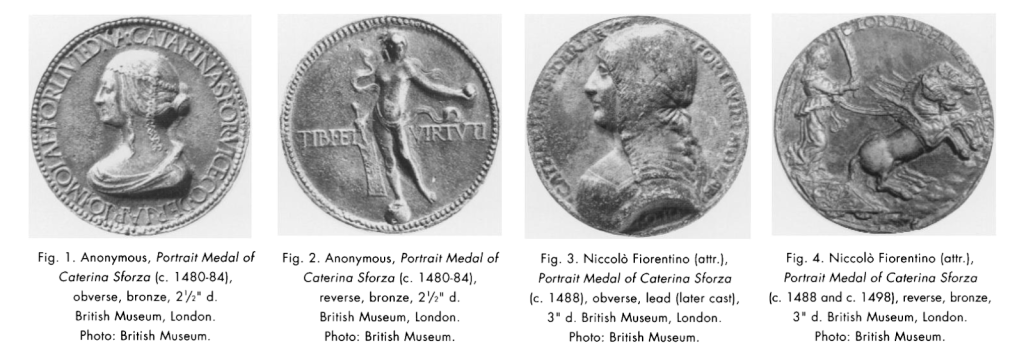
While Caterina was already known for her peak femininity, this act also earned her some masculine traits in the light of society’s eyes (see Figure 1)11. In her time as regentes from 1488-1500, she further built her image as a strong leader despite wars and conspiracies waged against her. In this period, she allegedly got married in secret twice over, first to Giacomo Feo who was the brother of the castellan Tommaso Feo. After his death, which surprisingly was also an assassination, she married Giovanni de Medici who was of the secondary branch of the Medici family12. She had more children with both men, however, her youngest child, Giovanni delle Bande Nere became arguably the most famous – both as a father to the first Grand Duke of Tuscany, Cosimo I, as well as for his own life achievements as condottiero13. He was the child to eventually inherit his mother’s lifework, her manuscript Experimenti. The recording of the 454 recipes in her manuscript took her from her first marriage to Girolamo until her death in 1509.
Experimenti: a life’s work
Together with Girolamo, Caterina tried to build a proper public image as regents of both Imola and Forlì by rebuilding many parts of the cities, as well as adding parks and Caterina’s very own medicinal gardens. To further strengthen relations, a special kind of currency was used amongst the nobility, namely the currency of secrets. These secrets were alchemical recipes or the products thereof. As mentioned, the success of a house could depend on the beauty of the woman, and Caterina was often described as the ideal feminine beauty: she had fair skin, blonde hair with a reddish hue, and a small bosom, all of which were highly priced assets for women14,15. While these features could have been completely natural, it can be speculated that some of them can be attributed to her recipes. She has several recipes in her manuscript for lightening hair and skin, as well as for reducing breast size16. Having these desired features furthermore likely increased the value of her so-called ‘secrets’, making them a very good currency to strengthen relationships.
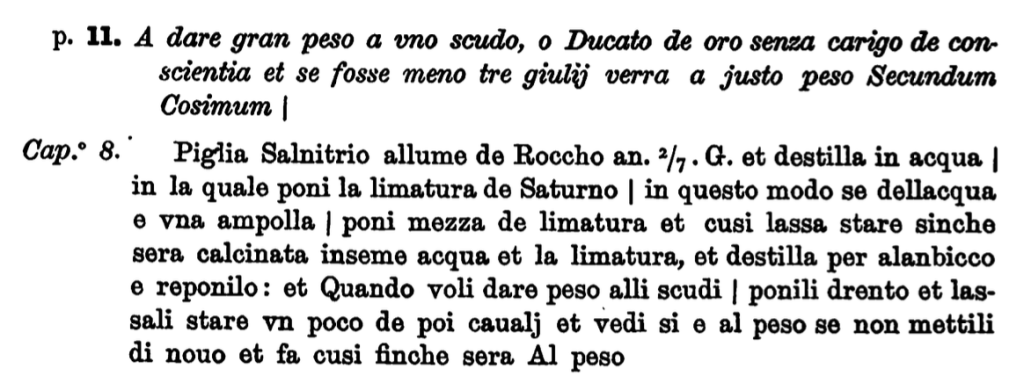
Other types of recipes that could influence one’s politics included the transformations of metal. One example of this is a recipe to enhance the weight of gold, tricking the receiver into thinking it is worth more than its actual value (see Figure 2)17. The latter types of recipes were considered fraudulent amongst the nobility, making it of the utmost importance that these recipes were secret. To ensure this secrecy while still being able to share the information via letters or manuscripts, they were often written down in code. The Latin language was frequently used to highlight the importance of a recipe, while it could also be used to keep a recipe secret from lower levels of society who did not speak Latin. Caterina used a mix of Italian, Latin, and code to write her recipes. Another manner in which Caterina possibly harbored the secrecy of her recipes, is by never mentioning the quantities of the ingredients. This can also imply that she expected the reader to have some form of knowledge of alchemy prior to reading. Alternatively, it can be speculated that whilst she shared her recipes for political gain, she did not actually want others to be able to use the recipes at their full potential – a sly way of ensuring she was always a step ahead.
One of these recipes, as stated by Ray & Lowe (2015, p.29), was used to remove blemishes from the face and requires “pulverized silver litharge dissolved in vinegar’. The original text, as found in Pasolini (1893, p.622) is as follows: “A fare la facia bianchissima et bella. Piglia letargirio de argento parte una trita suctile e poni in . aceto forte in una ampolla noua, e bolla tanto che sciemi el terzo poi stilla per feltro e serba ben turato poi piglia parte una de alume de piuma o uero de alume de rocho parte una solgemma (sic) parte meza canfor borace parte una incenso bianco parte una 2) parte (sic) | 2 | aqua rosata parte | 2 | oleo de genepro parte una | polueriza et metti nell’aqua rosa con lo oleo predetto et metti in loco netto | poi cola et destilla per feltro et serba et quando la voli adoperare tolli una goccia de ciaschuno sulla palma della mano e lauate la faccia | uenera | Bianca et Bella || Ancora tolli chiara de ouo Ben schiumata et mondata et destilla per lambicco | et e nobilissima a biancar la faccia et el collo.”
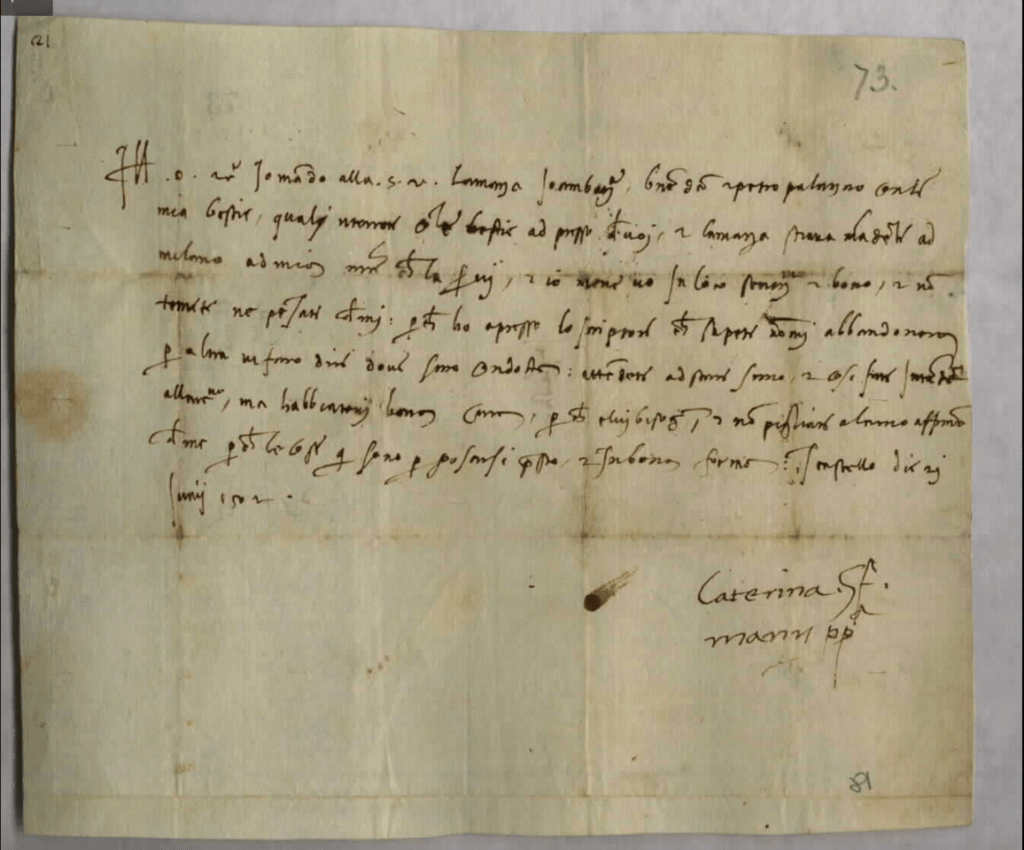
Caterina did have lots of people with whom she shared her passion for alchemy. Many of the letters confirming this are still preserved in archives (see Figure 3 for an example of such a letter)18. These letters also underline the importance of secrecy, especially the letters sent between her and Lorenzo de Mantechitis, who described himself as a humble servant to her19. The fact that Lorenzo was of lower standing than Caterina furthermore demonstrates that alchemy was not only an important pastime activity for the nobility. It was rather a widespread practice throughout every layer of society. It can even be argued that a lot of the cookery books are part of the practice, as many recipes included were seen as having medicinal purposes20,21.
Interestingly, some of the recipes in Experimenti also read as if they were cooking recipes. An example of such a recipe that Caterina used to make hand cream is as follows: “Take one pound of clean and ground bitter almonds, and leave them to soak overnight in water. Strain them through a cloth and discard the water. Then take two ounces of ground iris orientalis, two ounces of ground white mustard, four ounces of black mustard and four ounces of raw honey. Place all the above-mentioned ingredients in a clean and new glazed pot. Mix all the ingredients and cook over very low fire. Dilute with as much rose water as would fit in an eggshell, then let it cool down. It is amazing.”22 Her recipes only survived because Lucantonio Cuppano copied them to be passed on to Caterina’s son Giovanni delle Bande Nere.
Experimenti: the aftermath
Lucantonio was a member of the warband of Giovanni23. During his transcription of Caterina’s recipes, he clearly stated that Caterina authored the recipes and that he merely copied them24. He stresses this even further by adding notes such as “[…], as madame of furli used to do”25. Of some of these notes added to the manuscript, it is unclear if Caterina wrote them, or if Lucantonio added them on his own initiative.
There is, however, good evidence that the manuscript was meant as an object to be used rather than simply a prized possession. One particular recipe includes a note stating that the user can add their own notes and findings, with the addition of a few blank pages to write it down26. Some evidence of her manuscript being used by her Medici descendants can be found in a manuscript by the apothecary Stefano Rosselli. In this, he mentions that he received some valuable alchemical secrets from the Grand Dukes Cosimo and Francesco, as well as from Isabella who is the daughter of Cosimo and sister of Francesco27. These two Grand Dukes, who were direct descendants of Caterina, furthermore established large laboratories.
The home base of the Medici family was in Florence, thus this is where their alchemy mainly flourished. At the dawn of the seventeenth century, this city was even among the greatest centers of alchemy in Europe28. It is said that the family’s passion for and sponsorship of alchemy started with the first Grand Duke of Tuscany, Cosimo I. Him being the grandson of Caterina, and the heir to her manuscript, makes it highly plausible that Caterina was the original inspiration for this alchemical passion.
There were multiple sites at which the Medici royals performed their experiments, one of which was the Casino di San Marco laboratory. This was the aforementioned laboratory built by Grand Duke Francesco I. Its main purpose was to produce porcelain and glass works, as it was believed that the different colors of glass were clues for a deeper essence of the material29. Later on, this Casino also became the birthplace of the first manual of glassmaking, by Antonio Neri in 161230.
Neri was a Catholic priest and alchemist in the service of the Medici Duke Antonio de’ Medici, who was the son of Francesco I. While this flourishing passion for alchemy in the Medici line, which descended from Caterina, could be attributed to Caterina’s very own passion for the craft, it might also very well be that the family would have ignited this passion for alchemy without her involvement.
As mentioned in a previous part of this essay, alchemy was a practice found in all layers of society. The art of glass making can be traced back to the Middle Ages, and the art of alchemy goes back even further31. Given the nature of the Medici family as successful businessmen, it is highly likely that the Grand Dukes observed alchemy as a growing part of society where great profits could be found. Contrary, it could also be argued that Caterina’s manuscript, and successful dealings of secrets with other courts, inspired her Medici descendants to dive into the practice. A similar reasoning, of a Medici business mindset, can be applied here, as the dealings of secrets helped establish good relations with other courts32.
Caterina Sforza’s legacy
Caterina clearly was an extraordinary woman, having not only made herself to be a strong political figure in a mainly male-dominated world, but also having recorded 454 alchemical recipes during her lifetime.
Despite being born illegitimate, she received a humanistic education and became a Countess through marriage. After the death of her first husband, Riario, she earned her place in history as regent of Forlì and Imola. She used her alchemical recipes as a form of currency with members of other courts, as these ‘secrets’ were deemed to be of high value to daily life in the Renaissance period. Her third marriage with a member of the secondary branch of the Medici family resulted in her youngest son, Giovanni dalle Bande Nere. He would be the one to inherit his mother’s manuscript Experimenti. His son, Cosimo I, went on to become the first Grand Duke of Tuscany. Cosimo is furthermore known for his interest in alchemy, as are his son and grandson.
This leaves one to wonder if this was due to the inheritance of Caterina’s manuscript. There is, unfortunately, not yet any discovered direct evidence for this claim. All arguments in favor are mainly based on speculation. Therefore, the question of what Caterina’s alchemical influence was on the Medici family remains unanswered. Clues for solving this mystery have, however, been uncovered. Making comparisons between Caterina’s manuscript and the manuscripts left by Stefano Rosselli and Antonio Neri, as well as letters from her Medici descendants, could unveil if there are traces of her recipes in there.
Another interesting perspective for further investigation could be to look at Caterina de Medici (1519-1589), who became the queen of France and had correspondence with Florence. This Caterina is furthermore renowned for introducing the French court to Italian perfumes and is speculated to have dabbled in the art of poison mixing.
While Caterina Sforza was very influential during her lifetime, it remains unclear if the same can be said about her manuscript after her death. What can be said for certain is that at least her son and his warband member Lucantonio showed great admiration for her work.
References
Primary sources
Archivio di Stato di Firenze. (2015). MEDICEO AVANTI IL PRINCIPATO | Ricerca su Filza (F. Klein, Ed.). As-Fi[At]Pec.cultura.gov.it. https://archiviodistatofirenze.cultura.gov.it/map/ricerca/ricerca-su-filza/
Machiavelli, N. (1848). Il principe, e Discorsi sopra la prima deca di Tito Livio. Italië: Le Monnier (Zambelli, A.). (p.354). https://www.google.nl/books/edition/Il_principe_e_Discorsi_sopra_la_prima_de/2C7kLwWIX4UC?hl=nl&gbpv=0
Pasolini, P. (1893) Caterina Sforza. Volume III. Degli Experimenti de la exma Sr Caterina da furlj Matre de lo inlluxmo Sr Giouanni de Medici. Copiati dagli autografi di lei dal conte Lucantonio Cuppano colonnello ai servigi Militari di esso Giovanni de’ Medici detto dalle Bande Nere. Ermanno Loescher E C, (p. 599-807). https://www.google.nl/books/edition/Caterina_Sforza/CjAszIQ5ZzMC?hl=nl&gbpv=0
Secondary sources
Agnolo Firenzuola. (1992). On the beauty of women (Edited and translated by K. Eisenbichler & J. Murray). University Of Pennsylvania Press.
Albala, K. (2002). Eating right in the Renaissance. University Of California Press.
Beretta, M. (2017). Glassmaking Goes Public: The Cultural Background to Antonio Neri’s L’Arte Vetraria (1612). Technology and Culture, 58(4), (p.1046–1070). https://doi.org/10.1353/tech.2017.0113
Boer, P., & Engle, P. (2010). Antonio Neri: An Annotated Bibliography of Primary References. Journal of Glass Studies, 52, (p.51–67). http://www.jstor.org/stable/24191202
da Gorzano, Carlo Coppi (2015). Il conte Lucantonio Coppi detto Cuppano: ultimo condottiero delle Bande nere e dimenticato governatore generale di Piombino (1507-1557). Rivista araldica. 3 (1960). https://piombino.iswebcloud.it/download/allegati/195/7251_V03-Il%20Conte%20Luciano%20Coppi%20detto%20Cuppano.pdf
Hairston, J. L. (2000). Skirting the Issue: Machiavelli’s Caterina Sforza*. Renaissance Quarterly, 53(3), (p.687–712). https://doi.org/10.2307/2901494
Hedesan, G. D. (2021). Alchemy and Paracelsianism at the Casino di San Marco in Florence: An Examination of La fonderia dell’Ill.mo et Ecc.mo Signor Don Antonio de’ Medici (1604). Nuncius, 37(1), (p.119-143). https://doi-org.proxy-ub.rug.nl/10.1163/18253911-bja10014
Hollingsworth, M. (2018). FAMILY MEDICI: the hidden history of the Medici dynasty. Pegasus Books.
Hopkins, A. J. (1918). Earliest Alchemy. The Scientific Monthly, 6(6), 530–537. http://www.jstor.org/stable/22599
Jensen, D. L. (1978). Catherine de Medici and Her Florentine Friends. The Sixteenth Century Journal, 9(2), 57–74. https://doi.org/10.2307/2539663
Merriam-Webster. (n.d.). Condottiere. In Merriam-Webster.com dictionary. Retrieved November 6, 2024, from https://www.merriam-webster.com/dictionary/condottiere
Nummedal, T. E. (2011). Words and Works in the History of Alchemy. Isis, 102(2), 330–337. https://doi.org/10.1086/660142
Palmer, R. R., Colton, J., & Kramer, L. (2002). A History of the Modern World (9th ed., p. 54–67). McGraw-Hill.
Ray, M. K., & Lowe, K. J. P. (2015). Caterina Sforza’s Experiments with Alchemy. In Daughters of Alchemy (pp. 14–45). Harvard University Press. http://www.jstor.org/stable/j.ctt1c84d90.4
Rosselli (1593), Mes secrets: A Florence au temps des Medicis 1593: patisserie, parfumerie, medecine (ed. Rodrigo de Zayas, Paris: J. M. Place, 1966).
Soest. M. (2011). Caterina Sforza ist Mona Lisa. Die Geschichte einer Entdeckung. Deutscher Wissenschafts-Verlag.
Strathern, P. (2007). The Medici: godfathers of the Renaissance. Vintage Books.
Sutherland, N. M. (1978). Catherine de Medici: The Legend of the Wicked Italian Queen. The Sixteenth Century Journal, 9(2), 45–56. https://doi.org/10.2307/2539662
de Vries, J. (2003). Caterina Sforza’s Portrait Medals: Power, Gender, and Representation in the Italian Renaissance Court. Woman’s Art Journal, 24(1), 23. https://doi.org/10.2307/1358803
de Vries, J. (2010). Caterina Sforza and the Art of Appearances: Gender, Art, and Culture in Early Modern Italy. Ashgate, (p. 227-274).
Footnotes
- The portrait by Credi is named Portrait of a Young Woman with Jasmine. It is mere speculation that this portrait depicts Caterina. Joyce de Vries discusses the possibility of this woman being Caterina in her book Caterina Sforza and the Art of Appearances: Gender, Art, and Culture in Early Modern Italy (Ashgate, 2010) p.259. Here de Vries discusses how the fortress in the background and the jasmine in the hands of the woman are possible indicators. Caterina often used a fortress as a symbol of power on her coins, and the jasmine could be a symbol for her gardens and experiments (see de Vries (2003) for more information on these coins). There are unfortunately few surviving images of Caterina of which it is certain that it is depicting her. For more in depth information on that topic, consult Chapter 5 (p.227-274) of de Vries her book. I want to express my gratitude towards Joyce de Vries for being so kind as to personally share Chapter 5 of her book with me. ↩︎
- Hairston, 2000. The translation of the original text from Machiavelli as mentioned by Hairston, p.690: “In Forlì conspirators killed Count Girolamo and captured his wife and and small children. These conspirators knew they were not secure if they were not masters of the fortress, but the castlan was unwilling to surrender it. Then Madonna Caterina (for so the Countess was called) promised that if the conspirators would let her enter the fortress, she would have it surrendered to them; they might keep her children as hostages. With that promise, they let her enter. As soon as she was inside, she reproached them from the wall with the death of her husband, threatening them with every kind of revenge. And to show that she did not care about her children, she uncovered to them her genital members, saying that she still had means for producing more children.” The Italian text is as follows (Machiavelli, 1848, p.354): “Ammazzarono, alcuni congiurati Forlivesi, il conte Girolamo loro signore, presono la moglie ed i suoi figliuoli che erano piccoli; e non parendo loro poter vivere sicuri se non si insignorivano della fortezza e non volendo il castellano darla loro, Madonna Caterina (che cosi si chiamava la contessa) promise a’ congiurati, che se la lasciavano entrare in quella, di farla consegnare loro, e che ritenessono appresso di loro i suoi figliuoli per istatichi. Costoro sotto questa fede ve la lasciarono entrare; la quale come fu dentro, dalle mura rimproverò loro la morte del marito e minacciogli d’ogni qualita di vendetta. E per mostrare che de’ suoi figliuoli non si curava, mostrò loro le membra genitali, dicendo che aveva ancora il modo a rifarne.” ↩︎
- de Vries, 2003. ↩︎
- Assassin’s Creed II (2009); Medici: Masters of Florence, season 3 (2016-2019); Condottieri (1937); The Borgias (2011-2013). ↩︎
- See Pasolini (1893) for a full Italian bibliography on Caterina, and a copied version of the manuscript from p.599 onward. ↩︎
- Hairston, 2000. ↩︎
- Palmer et al., 2002. ↩︎
- As directly quoted from Palmer et al., 2002, p.57. ↩︎
- Hairston, 2000. ↩︎
- Hairston, 2000. ↩︎
- The presence of both masculine and feminine attributes can be seen very well on the different types of medals that were made in her image. Medals representing her as being more feminine were fashioned while Girolamo was still alive. After his death, a medal was made of her standing on top of a triumphal cart. While this image in itself does not signify masculinity, the personification of victory on the medal does attribute masculine power to Caterina. This emblem was even adopted by Charles VIII of France due to its masculinity (de Vries, 2003). For a more in depth elaboration on the use of symbols and gender by Caterina, see de Vries (2003). ↩︎
- Giovanni di Bici (1368-1429) had two sons: Cosimo il Vecchio (1389-1464) and Lorenzo il Vecchio (1395-1440). Cosimo being the first son, obviously inherited the title as head of the family with his fathers business of the Medici bank. However, Lorenzo is the direct predecessor of Caterina’s husband and subsequently her son Giovanni dalle Bande Nere. Eventually, this ‘second branch’ became the primary Medici branch through inheriting the Dukeship to Florence after the death of Duke Alessandro (1492-1519). For a family tree, see Archivio di State di Firenze (2015). For more information on the history of the Medici family, consult: Strathern, P. (2007). The Medici: godfathers of the Renaissance. Vintage Books. Or: Hollingsworth, M. (2018). FAMILY MEDICI: the hidden history of the Medici dynasty. Pegasus Books. ↩︎
- Condottiero, or condottiere, is Italian for a mercenary leader between the 14th and 16th century in Europe (Merriam-Webster dictionary). ↩︎
- As directly quoted from Ray & Lowe (2015, p.31) “[…]…her fifteenth- century biographer, Jacopo Filippo Foresti da Bergamo described her as “one of the most beautiful women of our century, of elegant appearance and blessed with a marvelous figure.”[…]”. The quote by Jacopo Filippo Foresti da Bergamo was taken by Ray & Lowe from J. F. Foresti da Bergamo, De plurimis claris selectisque mulieribus [Ferrara: Lorenzo Rosso da Valenza, 1497], p.561. ↩︎
- Agnolo Firenzuola (1493-1543), was author of a sixteenth-century book on female beauty, called On the Beauty of Women. In this book, he holds a dialogue on the ideal beauty standards for women of that time period providing us with clear ideals. ↩︎
- One of these recipes, as stated by Ray & Lowe (2015, p.29), was used to remove blemishes from the face and requires “pulverized silver litharge dissolved in vinegar’. The original text, as found in Pasolini (1893, p.622) is as follows: “A fare la facia bianchissima et bella. Piglia letargirio de argento parte una trita suctile e poni in . aceto forte in una ampolla noua, e bolla tanto che sciemi el terzo poi stilla per feltro e serba ben turato poi piglia parte una de alume de piuma o uero de alume de rocho parte una solgemma (sic) parte meza canfor borace parte una incenso bianco parte una 2) parte (sic) | 2 | aqua rosata parte | 2 | oleo de genepro parte una | polueriza et metti nell’aqua rosa con lo oleo predetto et metti in loco netto | poi cola et destilla per feltro et serba et quando la voli adoperare tolli una goccia de ciaschuno sulla palma della mano e lauate la faccia | uenera | Bianca et Bella || Ancora tolli chiara de ouo Ben schiumata et mondata et destilla per lambicco | et e nobilissima a biancar la faccia et el collo.” ↩︎
- Literal translation of the recipe as seen in Fig. 2, translated with the help of Google Translate (untranslated words are in cursive): “To give a great weight to a shield, or a ducat of gold without charge of conscience and if it were less than three giulij it will come to a just weight according to Cosimo
Take saltpetre rock alum an 2/7.G. and distill it in water |in which you put the filings of Saturn | in this way if you have water and a vial | put half of the filings and leave them there until it is calcined together with the water and the filings, and distill them with an alembic and put them back: and when you want to give weight to the shields | put them inside and leave them there a little after the caution and see if and to the weight if you do not put them of again and do so until it is to weight” Pasolini, P. (1893, p.620). ↩︎ - To name one of the archives, many letters relating to the Medici family can be found in the (online) archive of Archivio di Stato di Firenze. More specifically, under the heading ‘Archivi Digitalizzati’ → ‘Mediceo avanti il Principato’ → ‘Ricerca’ → ‘Ricerca su Filza’ → ‘Filza 112 (Letters to Giovanni dalle Bande Nere), ‘Filza 77 (Letters to Riario family, Caterina Sforza and other members of the Medici. Doc. 73 is a letter written by Caterina, see Figure 3 for this specific letter). The bibliography by Pasolini (1893) also contains many letters, which consequently might be easier to translate than the originals from the archive. I can attest, as I have tried and failed to decipher the beautiful cursive Renaissance Italian as written by Caterina. ↩︎
- Ray & Lowe (2015, p.41) state that Lorenzo described himself as a “servant” to Caterina. To further underline this claim, the original letter, as can be found in Pasolini (1893, p.603-605) is signed: “Servitor Laurentio de Manthechitis”. Ray & Lowe also added this translated quote from the same letter: “I also told him that I was employed with King Maximilian: incredible that someone like me would have reason to work with so exalted a signore.” The original, from Pasolini (1893, p.604) reads: “Li disse ancora che io era conducto cum lo Re Maximiano, cosa incredibile che uno mio paro havesse modo et via de condurse cum cussi alto S.re.” The way in which Lorenzo describes King Maximilian signifies even further that he deems himself of lower standing. Maximilian I (1459-1519) was married to Caterina’s sister, Bianca Maria Sforza, and king of the Romans. ↩︎
- There are many sources for cookery books dating from this period. One of those include: Jenner, M.S., Wallis, P., & Chakrabarti, P. (2007). Medicine and the market in England and its colonies, c.1450-c.1850. Another book, related to Renaissance cooking, looks more specifically at cooking as a form of medicine, similar to how today, we count calories, watch our sugar and fat intake, or eat ginger to combat a cold: Albala, K. (2002). Eating right in the Renaissance. University Of California Press. ↩︎
- The practice of cooking was also more easily accessible than other forms of alchemy that included rare ingredients and the use of very specific glass containers. This form of alchemy is called ‘vernacular alchemy’, as it derived itself from trades (such as cooking, but also metalworking or dye-making) rather than a humanistic education. (Nummedal, T. E. (2011). Words and Works in the History of Alchemy. Isis, 102(2), 330–337. https://doi.org/10.1086/660142). ↩︎
- This text is a translation made by Palmieri (2016-2017, p.13) of the original recipe. The original recipe, as found in Pasolini (1893, p.619), is as follows: “Piglia libbra una de amandole amare bem monde et piste e lassale stare una nocte in acqua amollo poi descola e bucta uia lacqua cum um panno et salua le amadole piste, Poi piglia oncie duj de irios de levante ben pisto. on. dui de senepe bianco ben piste oncie. 4. de senepe de saraciroscho | Mel crudo oncie. 4. poi mecti tucte le sopradicte cose, in una pigniacta noua inuetriata ben necta incorporate tucte insieme et ponile al foco et dalli el focho adaggio adagio et destempera cum tanta acqua rosa quanto staria in una cocia douo Poi lassa refredare et e facta mirabil cosa”. ↩︎
- There is an Italian bibliography available on Lucantonio Cuppano: da Gorzano, Carlo Coppi (2015). Il conte Lucantonio Coppi detto Cuppano: ultimo condottiero delle Bande nere e dimenticato governatore generale di Piombino (1507-1557). Rivista araldica. 3 (1960). ↩︎
- “In the name of God, in this book you will find some experiments taken from the original by the most illustrious madonna Caterina of Forlì, mother of the most illustrious signor Giovanni de Medici my lord and patron; and since the original was written in said madonna’s own hand … I will not mind the fatigue I undergo in copying them.” As taken from the essay Caterina Sforza and Experimenti Translation into English and historical-linguistic analysis of some of her recipes by Palmieri (2016-2017). This quote comes in turn from Ray & Lowe (2015, p.23). The original text is as follows: “In nome de Dio in questo libro senoteranno alcuni experimenti Cauati da lo originale de la inlluxma madonna Caterina da furli Matre de lo jlluxmo Sre joanni de medici mio Sre et patrone et per essere lo original scripto de man propria de dicta madonna … non me curaro durare fatiga arescriuerli…[…]” This is from: Pasolini, P. (1893). Degli Experimenti de la exma Sr Caterina da furlj Matre de lo inlluxmo Sr Giouanni de Medici. Copiati dagli autografi di lei dal conte Lucantonio Cuppano colonnello ai servigi Militari di esso Giovanni de’ Medici detto dalle Bande Nere. p.617. This information comes directly from the essay by Palmieri (2016-2017), however, I fact checked it with the book by Pasolini (1893) and found the text on a different page than indicated in the other sources. However, the part ‘Degli Experimenti de la exma Sr Caterina da furlj Matre de lo inlluxmo Sr Giouanni de Medici. Copiati dagli autografi di lei dal conte Lucantonio Cuppano colonnello ai servigi Militari di esso Giovanni de’ Medici detto dalle Bande Nere’ only starts at page 599, thus counting from there on it does come to p.19. ↩︎
- Quote taken from the essay Caterina Sforza and Experimenti Translation into English and historical-linguistic analysis of some of her recipes by Anna Palmieri (2016-2017). This quote in turn comes from Pasolini, P. (1893) p.618. of which the original text reads: “[…], como usaua madama da furli”. ↩︎
- “Per non essere le altre sue uirtu notate in dicto originale sinon per infinite, lassaro inquesto uolume lo spatio a causa si mai persona, ariuasse aquesta cognitione si degni comunicarlo perche e mortale peccato Tenere ascoso tanto tesoro” Pasolini (1893, p.613;3). The following text is the aforementioned quote translated to English as best as I personally could: “For no other than having virtue, notice that the original text is otherwise infinite, I will leave space in this volume so that if anyone comes to new knowledge, they may deign to communicate it because it is a mortal sin to keep such treasure hidden”. Ray & Lowe (2015, p.24) say about this piece of text that it is unclear if Caterina or Lucantonio added this to the manuscript. However, I am of the opinion that Lucantonio added this comment, based on the word virtu attributing masculine energy to the writer, as this word was used in this period to describe “the quality of being a man” (Palmer et al., 2002, p.57). Furthermore, ‘vir’means ‘man’. Therefore, ‘sue virtu’ would be directly translated to ‘his virtues’. However, this does not completely rule out the possibility of Caterina having added the comment, as she is known for having attributed masculine energy to herself as well, as discussed in previous parts of this essay. ↩︎
- The manuscripts by Rosselli can be found as edited versions in French by Rodrigo de Zayas (1966): Rosselli (1593), Mes secrets: A Florence au temps des Medicis 1593: patisserie, parfumerie, medecine (ed. Rodrigo de Zayas, Paris: J. M. Place, 1966). ↩︎
- Hedesan, 2021. ↩︎
- Boer & Engele, 2010. ↩︎
- Beretta, 2017. ↩︎
- Beretta (2017) discusses that glass making was already very important in especially the late Middle Ages, specifically in Venice and Murano. Consult the following article for some of the earliest accounts of alchemy: Hopkins, A. J. (1918). Earliest Alchemy. The Scientific Monthly, 6(6), 530–537. ↩︎
- As mentioned before, dealings of these secrets was a currency among the nobility, likely helping to get into someone’s good graces and strengthen alliances. ↩︎
 Bridging Science