

by Myrna Kooij
The first few months as a freelancer are full of decisions: from writing your first pitches to building your own website and brand as a science communicator. How do alumni of the Science, Education & Communication master take their first steps as freelancers? In part 1 of the series How to Freelance Marit Bonne shares her experience working as a science journalist in Valencia.
Marit Bonne
- Freelance Science Journalist since Jan 2025
- Originally from Texel
- Age: 25
- Jong VWN member
- Bachelor: Biology (2019-2020)
- Major Behavioural Neuroscience
- Minor Education
- Master: SEC (2022-2025)
- External assignment NTR Wetenschap
- Internship VHTO
- Current assignment: since Febr 2026 a fellow for Frontiers.
- Task: exploring ongoing research in women’s health
- Website: https://maritbonne.nl/
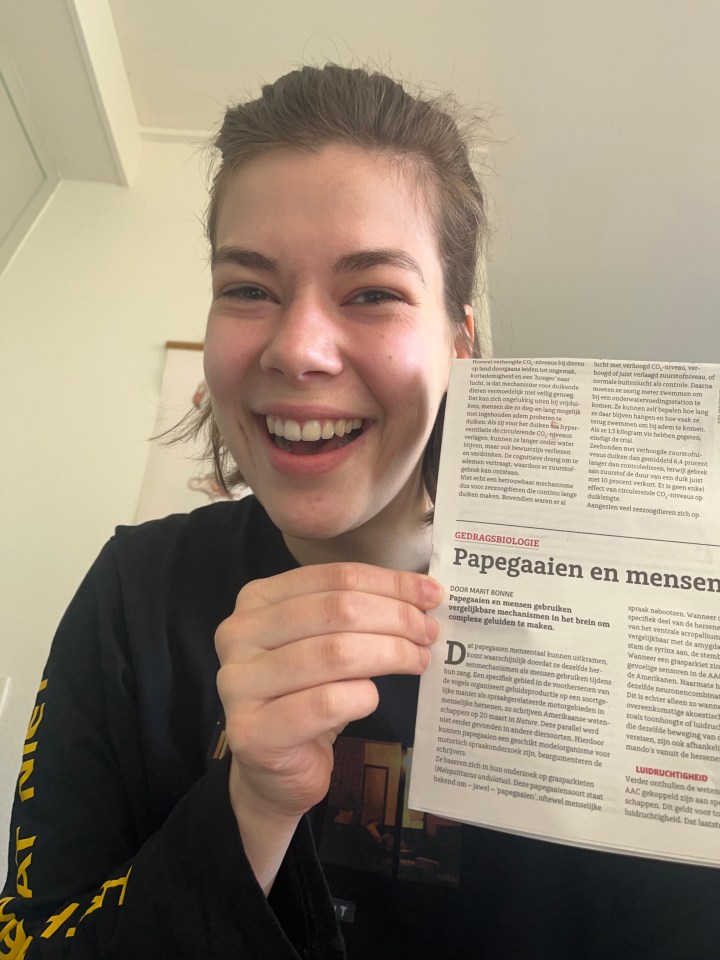
Alumna Marit Bonne is a freelance science journalist. Currently, she is staying in Valencia as a fellow for Frontiers, a European science journalism residency programme. As a fellow, she works as an independent science journalist while shadowing a research group. Marit has been enjoying her time there: “You’re more than a journalist.”
Marit is tasked to explore ongoing research in women’s health, which is an understudied topic. The research is still top secret, and Marit will soon reveal all details in her own podcast series, of which the first episode has been published. What she can share already is that the research team is using a rather futuristic machine that keeps the uterus of a donor alive, which enables them to better understand uterine conditions in the future such as endometriosis, pre-eclampsia, and uterine fibroids.
“What I enjoy most is the freedom it brings and the ability to plan in my own time.”
How to find your first freelance assignments
Marit started working on her writing skills already during her biology bachelor, with the column Marit’s Mythbusters in the magazine of her study association GLV Idun. During her communication master she started her writing career writing as a student-assistant for Ukrant. She approached the Ukrant with a pitch for her first assignment as a freelancer. In the first months of her freelancing career she wrote an article on the similarites of the parrot and human brain for BioNieuws and translated a research proposal to b1-level for the Hersenstichting.
Marit’s golden tip: Cast your net wide. And don’t give up when your first pitches are turned down.
How to create your first website
She first bought her domain name https://maritbonne.nl/ via Strato (#Nospon), as that was the cheapest option for the first half year. Then she built the content blocks using templates and Plugins from WordPress. “It is an investment, but with two days of work, you should have a working website.”
She shares the process was a lot of trial and error. “I had problems uploading my logo, which I found out needed to be a SVG file.” She also finds it important to be accessible to international media. “I used a plugin for the English version, which took me two afternoons to figure out.”
Marit’s golden tip: Look at other people’s websites to find inspiration. For example science communicators Anne van Kessel, Ronald Veldhuizen or Stan van Pelt.
How to develop your personal brand
When developing your personal brand, it can be a challenge to come up with what makes you stand out from other science communicators. “It can help to have your niche,” Marit shares, but she still struggles with this: “I like everything. One moment I want to write about astronomy, and the other on medical biology.”
To improve, Marit read the Dutch survival book for freelance journalists called Hosselen, Harken en andere Handigheden, in which science journalist Jop de Vrieze advises ‘serial monogamy‘. In short, this means that you commit yourself to a theme and allow yourself to fully dive into a subject, before moving on to the next series writing on a new theme. For example, Marit’s current focus is completely on women’s health, using her own background in biology.
Marit’s golden tip: Use your background to profile yourself. Say: “I know how science works, I know how to read papers and how to translate the message.”
How to network
As Marit is staying in Valencia, but is planning to go back to the Netherlands, she maintains contact with her Dutch network, for example by asking for advice: “For my podcast, I called with experienced people and asked how they do it.” When she started freelancing, she joined VWN, the association for science journalism and communication. She joined networking drinks and became an active member by organising events together with the Jong VWN committee. “It brought me a lot. It’s a very open but small community, with a focus on science.”
Next to that association, she became a member of the Nederlandse Vereniging van Journalisten (NVJ), which have a reduced fee for young professionals and students. Marit explains: “They help you with copyright, so for example when someone stole your article, they can help you get compensation.”
Marit’s golden tip: Actually go to networking drinks to build your network.
 Bridging Science